
Zirconia grinding media is the undisputed standard for high-purity ceramic processing because it entirely eliminates the structural degradation and ionic leaching that ruin advanced formulations. When operating high-energy ball mills or vibratory chambers for extended runs, traditional steel or glass beads inevitably shed micro-particles into your liquid suspension. This unavoidable contamination forces you into a high-wear, frequent-downtime cycle that severely impacts both yield consistency and operational profit margins. Deploying premium High-Purity Zirconia specifically resolves these vulnerabilities by maintaining an indestructible, chemically inert barrier during your most aggressive milling applications.
Why Select High-Purity Zirconia for Grinding?
Selecting High-Purity Zirconia prevents the unpredictable chemical and physical variables that notoriously ruin advanced ceramic batches. Your production lines demand absolute chemical containment, and inferior media will inevitably shed structural fragments into the slurry matrix. Implementing these advanced components permanently protects your materials from iron, silica, or alumina contamination. Consequently, your end-product maintains the strict phase purity and electrical properties required by your downstream clients.
What Are the Hidden Contamination Risks?
Here is the thing: common wear elements introduce unwanted metallic or ionic impurities directly into your slurry during intensive grinding cycles. If your current media breaks down, your entire multi-thousand-dollar batch is instantly placed at risk. You must actively minimize this vulnerability to protect your final chemical baseline by watching for these severe threats:
- Iron fragments from steel ruin essential optical clarity.
- Silica from cheap beads alters critical sintering shrinkage.
- Alumina shards trigger localized melting point shifts.
How Pure Materials Stabilize Production?
Think about it: phase purity prevents your structural material from undergoing spontaneous transformation under continuous shear stress. You need predictable physical behavior across all operational conditions to successfully pass strict quality assurance protocols. Choosing premium beads ensures you eliminate unexpected machinery failures and downstream processing bottlenecks through these key mechanisms:
- Tetragonal stability perfectly absorbs impacting forces.
- Monoclinic reduction effectively prevents stress cracking.
- Stabilizer balance ensures consistent crystalline integrity.
Key Takeaway: Selecting high-integrity milling media actively prevents cumulative microstructural contamination and ensures absolute batch-to-batch chemical stability.
| Contaminant Source | Slurry Risk | Endpoint Consequence |
|---|---|---|
| Steel Media | Heavy Iron Leaching | Discolored ceramic glazes |
| Glass Beads | Silica Infusion | Incorrect thermal shrinkage |
| Premium Ceramic | Zero Leaching | Absolute phase purity |
Upgrading your processing media fundamentally transforms your quality control from reactive troubleshooting to proactive assurance.
How Does High-Purity Zirconia Stop Acid Corrosion?
High-Purity Zirconia entirely stops acid corrosion because its dense crystalline matrix is inherently non-reactive to both low-pH and high-pH solutions. When attacking aggressive chemical mixtures, you cannot afford to have your mechanical grinding tools dissolve and pollute the tank. This premium material survives continuous submersion in extreme solvents without experiencing any localized pitting or structural decay. By eliminating these corrosive pathways, you successfully protect complicated formulations from unwanted chemical drift.
Can It Survive Highly Aggressive Slurries?
Let’s face it: aggressive chemical slurries will rapidly dissolve metal and low-grade ceramic components inside your industrial chamber. You encounter severe volumetric degradation whenever your mix drops below a pH of four or enters highly alkaline parameters. Deploying a fully inert material completely neutralizes the threat of aggressive solvents breaking down your primary binding agents.
- Acidic baths quickly erode standard metal oxides.
- Alkaline solutions aggressively eat away at silica structures.
- Solvent-rich compounds destroy inferior polymer coatings.
Why Does Ionic Leaching Destroy Efficiency?
But there is a catch: dissolved ionic contamination is virtually impossible for your technicians to filter out once inside the suspension. You must stop these microscopic elements from migrating because they silently destroy the core matrix of your electronic ceramics. Opting for chemically stable tools guarantees these rogue ions never escape into the liquid environment in the first place.
- Leached iron destroys standard optical transparency.
- Dissolved copper ruins vital dielectric capacities.
- Sodium traces severely tamper with intricate sintering profiles.
Key Takeaway: Absolute chemical inertness radically prevents invisible ionic leaching, fundamentally protecting your advanced chemical formulations from critical structural drift.
| Material Grade | Acidic Defense | Alkaline Defense | Ion Release Risk |
|---|---|---|---|
| Premium Ceramic | Exceptional | Exceptional | Zero |
| Standard Alumina | Moderate | Weak | Moderate |
| Stainless Steel | Very Weak | Average | Severe |
Prioritizing chemical stability at the intense grinding phase remains the only proven method to eliminate irreversible ionic pollution.
What Drives High-Purity Zirconia Wear Limits?
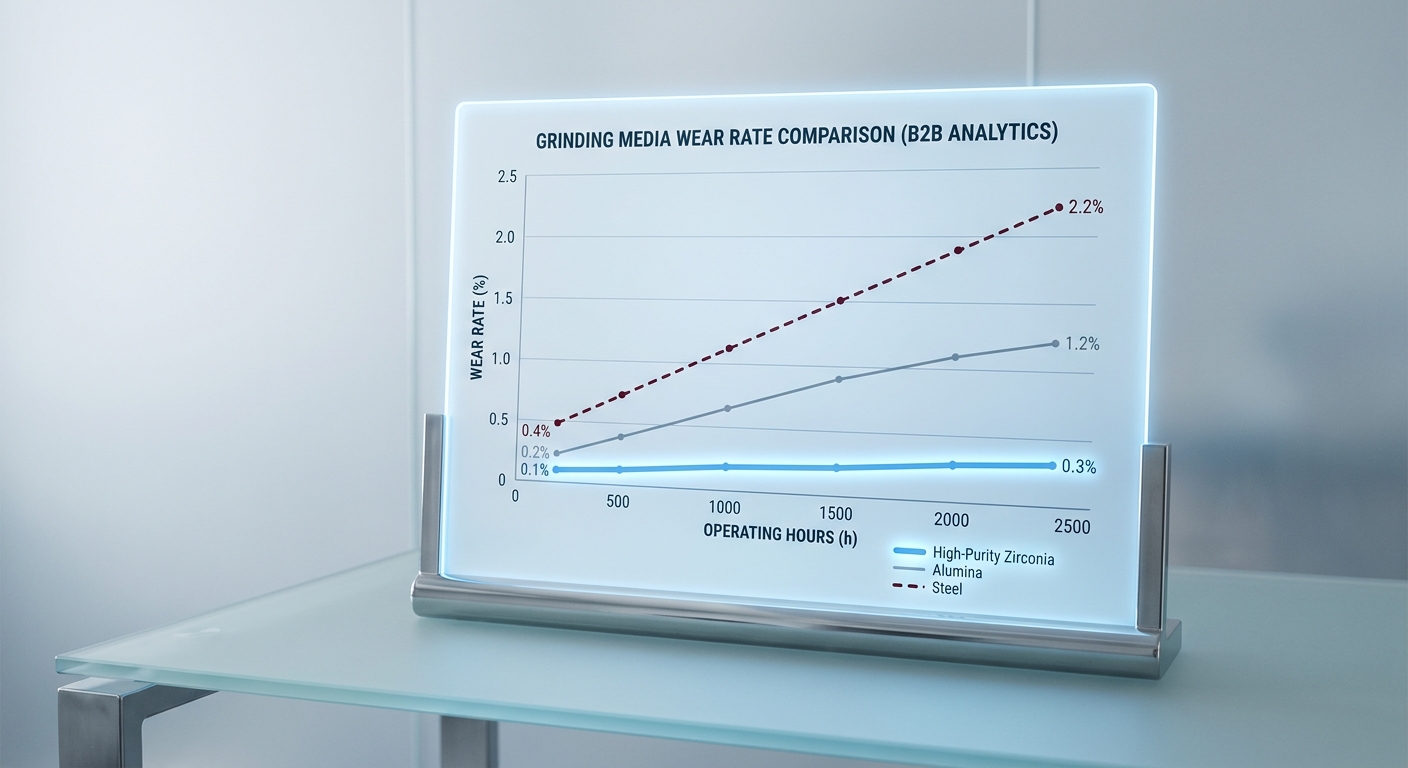
High-Purity Zirconia achieves incredible wear limits by leveraging a fully densified microstructure that contains zero abrasive failure points. Micro-fracturing and chipping are triggered by internal porosity, which causes standard materials to split open under sustained shear force. Operating with fully dense, stabilized beads guarantees millions of high-energy kinetic impacts without noticeable mass reduction. This mechanical resilience slashes your overall replacement cadence while simultaneously guarding against micro-debris contamination.
The Hidden Power of Microstructural Density
Here is why: maximizing internal density is the only way you can prevent aggressive shear forces from splitting your media apart. When you deploy densely packed ceramic matrices, you eliminate the localized stress concentration points that typically initiate catastrophic fracturing. Your high-energy collisions demand incredible surface hardness to resist continuous abrasive scratching from the raw feed particles.
- Pore-free interiors block destructive liquid absorption entirely.
- Tight grain boundaries smoothly stop microscopic crack propagation.
- Superior hardness directly opposes harsh raw material abrasion.
How Do Micro-Cracks Sabotage The Mill?
The truth is: even a microscopic surface crack will act as the genesis point for total media breakdown during heavy operations. You risk enormous cavitation forces inside wet mills violently forcing these tiny surface flaws to crack wide open. Mastering precise sintering temperature control allows you to implement grinding beads that are completely shielded from these rapid failure paths.
- Intergranular stresses easily destroy weakly bonded beads.
- High-pressure environments aggressively exploit surface defects.
- Weak grain boundaries naturally invite vastly accelerated wear rates.
Key Takeaway: Maximizing microstructural density drastically reduces overall surface degradation and prevents hazardous micro-shards from polluting your intensive milling runs.
| Sintered Density | Hardness Level | Hourly Wear Rate | Expected Lifespan |
|---|---|---|---|
| > 6.00 g/cm³ | 1200+ HV | < 0.01% | 5,000+ Hours |
| 5.80 g/cm³ | 1000 HV | 0.05% | 2,500 Hours |
| < 5.50 g/cm³ | 800 HV | 0.15% | 800 Hours |
Tracking fundamental mass reduction against operational hours exposes exactly how higher density directly yields profitable component longevity.
Why Is High-Purity Zirconia Bead Geometry Vital?
High-Purity Zirconia bead geometry is vital because precise dimensional tolerances ensure maximum kinetic energy transfer across the entire contact zone. If your specified media sizes are inconsistent, your chamber will suffer from erratic shear distribution and create massive dead zones in the slurry. Deploying flawlessly rounded shapes abruptly eliminates hydraulic packing and allows every single bead to contribute equally to the ongoing reduction cycle. This uniform contact density is precisely what enables you to hit aggressive sub-micron targets without over-milling the batch.
Expanding Your Active Grinding Contact Area
Here is the key: upgrading to specialized radius-end cylinders provides you with vastly superior contact zones compared to traditional spherical alternatives. You can dramatically accelerate your core grinding stages by shifting from simple isolated point contact to highly efficient linear line contact. Optimizing this exact surface geometry allows you to naturally process thicker, high-viscosity suspensions with remarkably balanced shear forces.
- Line contact efficiently distributes raw kinetic power more evenly.
- Radius-ends drastically reduce counterproductive dead volume pockets.
- Optimized packing density guarantees constant and smooth particle impacts.
Does Size Tolerance Predict Output Quality?
Think about it: failing to enforce strict size tolerances permanently traps your production line in a cycle of uneven particle outputs. You will actively damage your overall yield if oversized components randomly crush the product instead of carefully shearing it down. Installing highly calibrated, uniformly sized media thoroughly guarantees that your advanced powders hit their precise required diameters seamlessly.
- Oversized tools violently smash rather than smoothly grind.
- Undersized beads blindly slip through downstream filtration screens intact.
- Uniform dimensions completely halt dangerous internal chamber packing.
Key Takeaway: Utilizing precise radius-end geometry coupled with ultra-narrow size tolerances significantly maximizes your targeted shear area while efficiently preventing over-milling.
| Media Shape | Internal Surface Area | Kinetic Transfer | Resulting Grind Accuracy |
|---|---|---|---|
| Radius Cylinder | Maximum | Exceptional | Sub-micron precise |
| Flawless Sphere | High | Very Good | Fine micron |
| Irregular Bead | Low | Poor | Coarse and uneven |
Upgrading gracefully from standard spheres to precision radius cylinders fundamentally shifts your primary action from random crushing to calculated shearing.
How Does High-Purity Zirconia Maximize Efficiency?
High-Purity Zirconia maximizes operational efficiency by leveraging its immense mass-to-volume ratio to dramatically accelerate hardware grinding cycle speeds. Low-density tools require excessive run times to reach target particle sizes, which ultimately burns through your highly constricted operational power budget. Relying on highly dense materials delivers massive kinetic impacts that cleanly shatter target particles in half the normal processing time. By rapidly reducing the overall cycle length, you successfully shield heat-sensitive electronic slurries from dangerous internal thermal degradation.
Generating Serious Kinetic Mass Advantage
But wait, there’s more: substituting lighter beads for heavyweight super-composites allows your machines to hit sub-micron parameters almost twice as fast. You are actively wasting strict industrial electricity every time you force a lightweight glass bead to attempt a high-energy reduction. Superior structural mass guarantees that individual chamber collisions generate optimal kinetic fractures, vastly improving your overall facility turnover rates.
- Lower media mass directly cripples individual kinetic impact energy.
- Excessive runtime violently spikes your baseline electrical consumption.
- Prolonged chamber friction unintentionally cooks delicate polymer binders.
Stripping Away Cumbersome Filtration Steps
Let’s face it: dealing with chipped micro-shards forcefully blocking your fine output filters is an absolute nightmare for continuous manufacturing. You lose precious hours of automated production whenever technicians are forced to manually unclog and thoroughly clean the downstream separation mechanisms. Shifting directly to fracture-proof elements ensures your fluid streams stay pristine, effectively rendering intensive secondary washing cycles completely obsolete.
- Large structural fragments violently rip open fragile output screens.
- Micro-debris forces your team into massive rework and heavy washing.
- Filter blockages instantly halt your continuous automated manufacturing lines.
Key Takeaway: Deploying maximum density media intensely concentrates your kinetic impacts, securing faster throughput speeds while simultaneously driving down overall electricity usage.
| Media Variant | Standard Cycle Time | Power Consumption | Filter Maintenance |
|---|---|---|---|
| High-Density Ceramic | 4 Hours | Baseline (1x) | Every 50 Cycles |
| Standard Alumina | 8 Hours | Double (2x) | Every 10 Cycles |
| Silica Glass | 12 Hours | Triple (3x) | Every 2 Cycles |
Slashing your baseline cycle time easily pays dual dividends by expanding facility throughput and vigorously protecting profit margins from soaring energy tariffs.
Can High-Purity Zirconia Slash Total Process Costs?
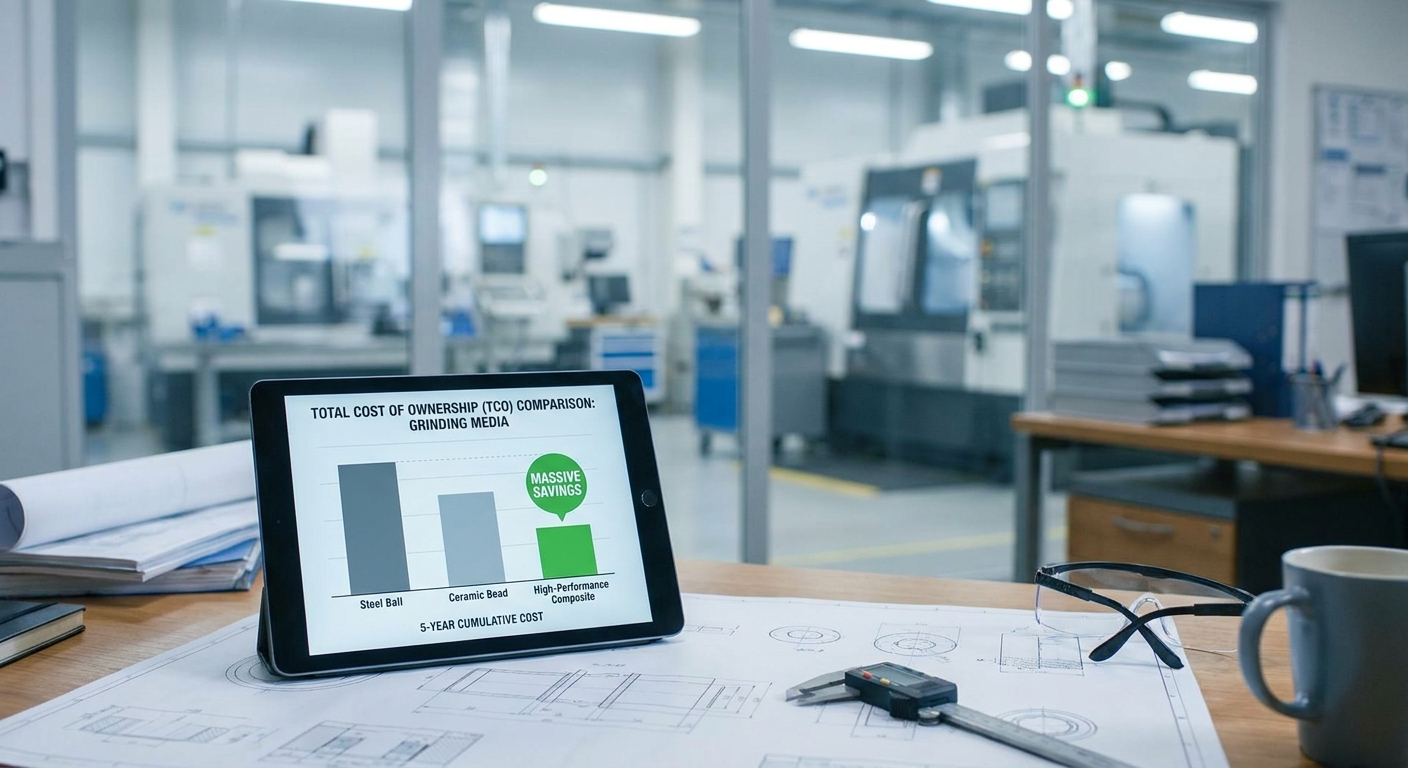
High-Purity Zirconia slashes total process costs by radically extending equipment lifespans and decisively eliminating the immense risk of multi-thousand-dollar batch rejections. Procurement teams who simply chase the absolute lowest upfront purchase price inevitably suffer from catastrophic total cost of ownership (TCO) explosions. Implementing ultra-durable compounds heavily stabilizes your maintenance budget by keeping your primary chambers running cleanly for thousands of uninterrupted hours. This operational predictability entirely safeguards your raw profit margins from the hidden compounding expenses of constant mechanical reloading.
Winning The Total Cost of Ownership Battle
Here is the key: constantly repurchasing cheap industrial beads will very rapidly exceed the initial premium investment required for a highly durable solution. You are heavily hemorrhaging valuable capital every time a maintenance crew halts your automated system to perform a tedious media recharge. Equipping your dynamic mills with elite components fundamentally locks in your operational budget and abruptly eliminates sudden overhead spikes.
- Inferior physical products burn out more than three times faster.
- Mandatory machine downtime rapidly annihilates your daily profitability calculation.
- Manual cleaning tasks drastically cause baseline labor expenses to skyrocket.
Defeating the Massive Threat of Batch Rejection
The truth is: destroying a single high-value batch of advanced electronics costs significantly more than your entire annual internal media budget. You permanently sever essential customer trust the moment your final chemical assay reveals metallic impurities actively exceeding predetermined safety limits. Sourcing an absolutely indestructible grinding agent acts as the ultimate insurance policy, ensuring every physical output strictly passes rigorous quality control validation.
- Contaminated material heavily mandates extremely costly physical disposal protocols.
- Impurity spikes instantly trigger incredibly severe supply chain audits.
- Troubleshooting rogue elements demands endless advanced engineering hours.
Key Takeaway: Adopting premium ceramic products entirely secures long-term cost supremacy by dramatically reducing tedious replacements and blocking devastating chemical yield losses.
| Expenditure Factor | Premium Media | Cheap Media | Annual Financial Effect |
|---|---|---|---|
| Initial Acquisition | High | Low | Yields ROI within 3 months |
| Chamber Reloads | 1x Annually | 4x Annually | 75% drop in maintenance downtime |
| Yield Reject Rate | < 0.1% | > 4.5% | Saves massive raw material costs |
Transitioning your core procurement focus from isolated invoice pricing to long-term lifecycle metrics ultimately reveals the true devastating cost of subpar materials.
How Is High-Purity Zirconia Sintering Density Controlled?
High-Purity Zirconia sintering density is strictly controlled through precision thermal ramp rates that completely eliminate internal voids and lock in the crystalline matrix. Inaccurate baseline firing automatically results in a highly porous, fundamentally compromised structure that desperately cannot withstand extreme fast rotational forces. Mastering these exact delicate thermal profiles within industrial kilns effectively secures a flawlessly dense core that easily deflects aggressive mechanical impacts. Delivering this verified structural perfection continuously empowers advanced applications to perform flawlessly in severe defense and modern aerospace sectors.
Validating Sintering Thermodynamics
Think about it: failing to isolate the exact required target temperature will immediately lead to incomplete phase conversion and critical massive density failures. You severely disrupt the vital tetragonal matrix whenever excessive thermal heat provokes unpredictable and volatile monoclinic crystalline expansion. You must absolutely mandate superior thermal consistency from your raw supplier to ensure every single delivered batch possesses identical compressive strength.
- Insufficient heat permanently abandons highly active micro-pores inside the core.
- Over-firing vigorously provokes massive and weakening structural grain magnification.
- Gradual thermal transitions effortlessly preserve supreme interior core toughness.
Eradicating Dangerous Internal Porosity
But there is a catch: microscopic voids hidden deep inside your fragile beads act as chemical sponges that aggressively cross-contaminate entirely separate production runs. You invite explosive mechanical failure when these tiny isolated pores trap ambient gases that expand violently under heavy frictional heat. Mandating a completely solid, flawlessly pore-free lattice rigorously guarantees absolute isolation from ambient liquid absorption during sensitive medical-grade processing.
- Absorbed slurry chemically poisons your subsequent high-value product variations.
- Trapped oxygen pockets actively trigger violent internal micro-explosions inside mills.
- Porous outer shells quickly succumb to standard baseline hydraulic pressure.
Key Takeaway: Exacting kiln management actively enforces a complete zero-porosity internal matrix, producing unprecedented compressive capabilities and ultimate structural fatigue resistance.
| Thermal Execution | Final Density | Internal Porosity | Compressive Limit (MPa) |
|---|---|---|---|
| Perfected Sintering | ≥ 6.02 g/cm³ | < 0.05% | 2000+ |
| Average Firing | 5.80 g/cm³ | 1.50% | 1500 |
| Flawed Ramp Rate | 5.40 g/cm³ | 5.00% | 800 |
Eliminating internal air pockets entirely during thermal synthesis is the sole mechanism that transforms standard powder into an impenetrable industrial weapon.
What Solves High-Purity Zirconia Thermal Shock Risks?
High-Purity Zirconia thermal shock risks are practically solved by injecting perfectly precise amounts of yttria stabilizer to permanently lock the high-strength tetragonal phase. Without strict advanced chemical stabilization, extreme temperature shifts between active wet milling and dry cleaning cycles cause massive physical volumetric expansion. This sudden volume shift actively creates catastrophic structural fracturing that immediately and ruthlessly destroys standard undoped materials. By maintaining optimal required chemical balances, you ensure your essential processing media beautifully endures severe temperature swings without generating a single micro-crack.
Discovering the Yttria Stabilization Sweet Spot
Let’s face it: unless you explicitly demand proper chemical doping, your plain ceramic tools will shatter the second they rapidly cool down from high temperatures. You require an exact targeted three mole percent yttria blend to successfully freeze the ultra-tough tetragonal structure securely in place at room temperature. Providing too much stabilizer aggressively downgrades the compound’s innate physical flexibility, rendering it entirely excessively rigid for sustained heavy collisions.
- Strategic doping chemically blocks volatile phase deterioration entirely during operation.
- Three percent boundaries successfully offer peak mechanical shock absorption.
- Over-stabilization blindly sacrifices crucial kinetic surface durability parameters.
Neutralizing Rapid Temperature Fluctuations
Here is why: bombarding hot ceramic interior tools with a blast of chilled cleaning solvent will instantly tear apart any unstabilized molecular network. You encounter extreme structural risk when your continuous automated processes subject the identical processing agent to vicious hot-and-cold extremes. Investing heavily in stabilized defensive agents effectively armors your machinery entirely against sudden spontaneous fracture during mandatory high-pressure washdowns.
- Volatile phase shifts rapidly rip standard mechanical components inside out.
- Sudden targeted refrigeration instantly cracks deeply weakened microstructures.
- Doped advanced molecules effortlessly deflect brutal external temperature shock.
Key Takeaway: Intelligent chemical stabilization utilizing pure yttria definitively halts destructive internal phase transitions, perfectly safeguarding your equipment from lethal thermal fracturing.
| Target Yttria Formula | Phase Locking | Thermal Deflection | Impact Flexibility |
|---|---|---|---|
| 3 mol% (Optimized) | Flawless | Exceptional | Supreme |
| 5 mol% (Over-loaded) | High | Average | Moderate |
| 0 mol% (Undoped) | Total Failure | Extremely Weak | Poor |
Securing precise yttria stabilization actively grants you the complete freedom to confidently run aggressive thermal cleaning regimes without ever fearing immediate structural collapse.
What Are Top High-Purity Zirconia Consulting Questions?

High-Purity Zirconia technical questions typically revolve around determining safe operational mixing parameters and maximizing the total ultimate longevity of the grinding installation. Process engineers consistently seek advanced guidance to completely prevent inadvertent systemic damage stemming directly from incorrect component pairing or improper chamber maintenance. Addressing these core foundational mechanical constraints actively empowers your maintenance division to deeply optimize daily processing variables and secure highly robust production environments. Clarifying these rules immediately greatly extends your operational runway and actively minimizes abrupt, extremely costly mechanical interruptions.
Solving Critical Engineering Operations
But wait, there’s more: you must ruthlessly enforce strict automated operational guidelines on the factory floor to completely stop preventable equipment degradation. You greatly increase your success rates whenever you train local engineers to visually inspect and carefully track kinetic variables across all shifts. Establishing an ironclad baseline protocol for chamber loading guarantees that you effortlessly extract the absolute maximum fiscal value from your premium components.
- You absolutely cannot safely mix vastly varying density profiles together.
- Heavier kinetic components will violently crush delicate lighter alternatives quickly.
- Weight drop tracking effectively predicts exact required safe replacement days.
Enhancing Daily Mechanical Defenses
The truth is: actively ignoring basic thermal and chemical interaction risks will rapidly destroy even the most highly expensive grinding configurations on the market. You strictly need to leverage engineered chemical inertness to confidently run highly acidic dispersions without instantly worrying about microscopic structural collapse. Understanding proper maintenance cycles strongly guarantees your massive premium investment naturally resists both extremely corrosive slurries and aggressive physical shear.
- Acidic chemical baths perform beautifully alongside fully inert ceramic shields.
- Yttria stabilization formulas easily outclass competing inferior stabilizer alternatives.
- Pure automated water blanks definitively represent the safest structural cleaning method.
Key Takeaway: Instituting extremely strict mechanical tracking paradigms entirely alongside proper preventative engineering training halts rogue equipment malfunctions and beautifully sustains optimal mixing precision.
| Processing Query | Recommended Action | Avoided Disaster |
|---|---|---|
| Can I mix densities? | Strictly isolate materials | Internal bead crushing |
| When to swap beads? | Track 10% weight loss | Sudden slurry contamination |
| How to properly clean? | Solvent blank cycles | Violent thermal fracturing |
Mastering the highly intricate rules of advanced technical engagement quickly transforms your base operators into powerful proactive defenders of your multimillion-dollar production yield.
How Do You Secure High-Purity Zirconia Logistics?
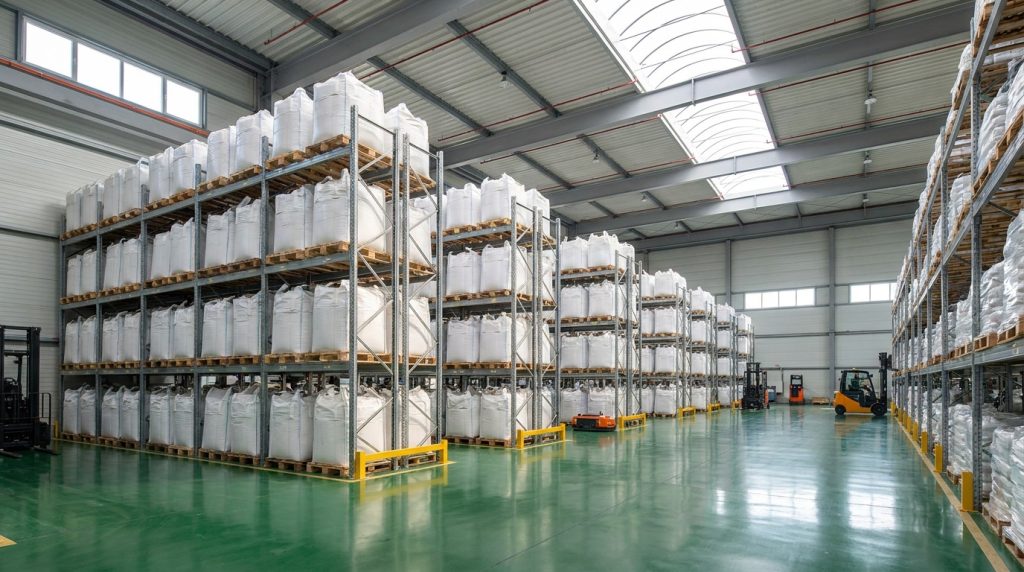
High-Purity Zirconia logistics are secured by exclusively contracting deeply with vertically integrated manufacturers who possess absolute structural control over their base raw materials. Relying on highly disorganized third-party international brokers completely compromises your ability to properly trace chemical contamination events directly back to their source origin. A direct structural engineering relationship continuously supplies the essential detailed testing documentation and physical traceability vehemently demanded by elite aerospace and medical auditors. Securing these vital direct channels fully ensures your factory lines never unfortunately stall due to sudden international shortfalls or catastrophic quality drifts.
Validating Your Primary Manufacturer
Think about it: outsourcing blindly to generalized third-party trading companies severely diminishes your critical access to immediate, root-cause troubleshooting when complex variables unfortunately fail. You must aggressively target primary manufacturers who physically precisely oversee every operational phase from initial sand extraction to final precision sintering control. This heavily concentrated oversight entirely protects your fragile operations from random volatile supply shocks and completely guarantees the chemical consistency of your continuous reserves.
- Direct authentic producers flawlessly control critical internal phase parameters seamlessly.
- In-house laboratory analytics immediately confirm strict base raw material purity.
- Dedicated holding silo capacity thoroughly halts unforeseen logistical delivery delays.
Locking Down Precision Custom Trials
Let’s face it: strictly standardized, off-the-shelf spherical dimensions simply will not effectively interface properly with incredibly cutting-edge, customized mechanical processing chambers. You violently demand an integrated firm that happily actively co-develops extremely specific sizing profiles to flawlessly match your unique kinetic velocity requirements. Executing a highly organized custom trial process effectively fully guarantees your custom parameters are flawlessly thoroughly debugged before you commit to immense production scaling.
- Customized exact diameters aggressively optimize extremely rare fluid target output.
- Tailored internal bulk packaging greatly streamlines your daily internal floor logistics.
- Collaborative advanced laboratory testing successfully ensures complete mathematical scale compliance.
Key Takeaway: Solidifying an ironclad contract deeply with a foundational primary producer guarantees continuous raw material verification, highly robust analytical paperwork, and heavily customized engineering support.
| Essential Paperwork | Validation Purpose | Crucial Measured Metric |
|---|---|---|
| Standard COA | Verifies chemical purity | ZrO₂ ratios and rare trace limits |
| Exact PSD Report | Confirms kinetic sizing | Precise D10, D50, D90 tolerances |
| Phase Analytics | Proves structural matrix | Confirmed tetragonal phase levels |
Mandating absolutely extensive analytical verification directly straight from the source origin heavily remains your strongest internal defense against devastating downstream chemical variations.
Conclusion
Eliminating microscopic cross-contamination and maximizing long-term kinetic stability actively represent the absolute fundamental cornerstones of modern advanced ceramic manufacturing. Trusting ordinary beads only breeds continuous internal part failure and severely volatile batch properties that ultimately cripple automated production schedules. ZrBrontec application engineering completely eliminates these hidden systemic risks by engineering pore-free, hyper-dense materials that violently refuse to crack under extreme aggressive friction. We believe that your multi-million dollar processing run heavily deserves absolutely nothing less than total material perfection at the intricate molecular level. To permanently upgrade your milling yields entirely and implement remarkably bulletproof global logistics, contact us today for incredibly detailed, application-specific custom trial protocols.
Frequently Asked Questions
Can I mix different bead parameters together in the same automated mill?
No, you cannot safely do this. Mixing heavy and light materials rapidly forces the incredibly dense components to brutally crush the lighter beads, destroying your entire batch with immediate catastrophic micro-shards.
What is the absolute best method to evaluate when my grinding elements are mechanically exhausted?
The best way is to monitor mass reduction strictly. You should securely initiate a complete immediate removal protocol the moment your total chamber load drops ten percent in recorded overall weight to avert critical contamination.
How do I know if a highly acidic chemical bath will effectively destroy my media infrastructure?
You do not need to worry if you utilize completely inert premium components. High-grade tools easily and completely withstand a pH drastically below four, meaning robust innate chemical resistance fully guarantees absolutely zero internal dissolving or metallic leaching.
Can I successfully push standard compounds directly into extreme hot-and-cold temperature washes?
Absolutely not. Unstabilized baseline components will quickly experience massive uncontrolled thermal shock and explode under pressure; always rigidly mandate yttria-stabilized chemistry for severe extreme temperature differentials.
What’s the best way to meticulously secure exact mathematical sizes for my highly unique machinery?
The best approach is exclusively co-developing structured trials with a completely direct, primary manufacturer. Vertically integrated firms will flawlessly mathematically match exact dispersion diameter distributions precisely to your specific internal geometric chamber dimensions.