
The three primary preparation methods of zirconia grinding media are pressing (uniaxial and cold isostatic), rolling (granulation), and dropping (titration or sol-gel). Selecting ceramic grinding media with improper sphericity or internal structural flaws leads to catastrophic media fracture, severe equipment wear, and costly product contamination in high-shear industrial dispersion. When operating high-energy wet milling circuits, low-grade beads break down prematurely under continuous mechanical shock, causing costly batch rejections and emergency shutdown delays. Upgrading your production line with high-purity Zirconia Grinding Beads manufactured through precision-controlled forming routes guarantees maximum wear resistance, high density, and smooth operational performance.
How Are Zirconia Grinding Beads Formed via Pressing?
Zirconia grinding beads are formed via pressing by compacting granulated ceramic powders into dense spherical green bodies using high-pressure mechanical dies or elastic molds. Industrial manufacturers rely on this process for medium-to-large diameter Zirconia Grinding Beads to ensure high green density prior to thermal treatment. Raw yttria-stabilized powders are combined with organic binders and spray-dried to maintain fluid consistency during loading.

What Is the Uniaxial Dry Pressing Method?
Uniaxial dry pressing feeds spray-dried powder into steel dies where automated mechanical rams apply linear pressure to form spherical compacts.
Here is the truth:
- High Output: Automated pressing machines produce thousands of dense green bodies per hour.
- Tight Tolerances: Precision dies ensure consistent dimensions across large production batches.
- Uniform Feed: Spray-dried granules flow smoothly to prevent weight fluctuations during filling.
Proper pressure regulation prevents spallation micro-cracks upon ejecting green spheres from rigid steel dies. Maintaining binder balance is essential for smooth mechanical release.
Key Takeaway: Uniaxial dry pressing provides an economical high-volume manufacturing route for medium-to-large ceramic media, provided compaction pressure is carefully calibrated.
| Compaction Parameter | Standard Target | Quality Impact |
|---|---|---|
| Powder Moisture | 3.0% – 5.0% | Ensures optimal granule flow and green strength |
| Pressing Pressure | 50 – 150 MPa | Determines initial density and sintering shrinkage |
| Binder Content | 1.0% – 2.0% | Prevents die sticking and structural capping |
Calibrating compaction pressure and binder moisture ensures consistent green body density across all pressed batches.
Why Use Rolling for Zirconia Grinding Beads Production?
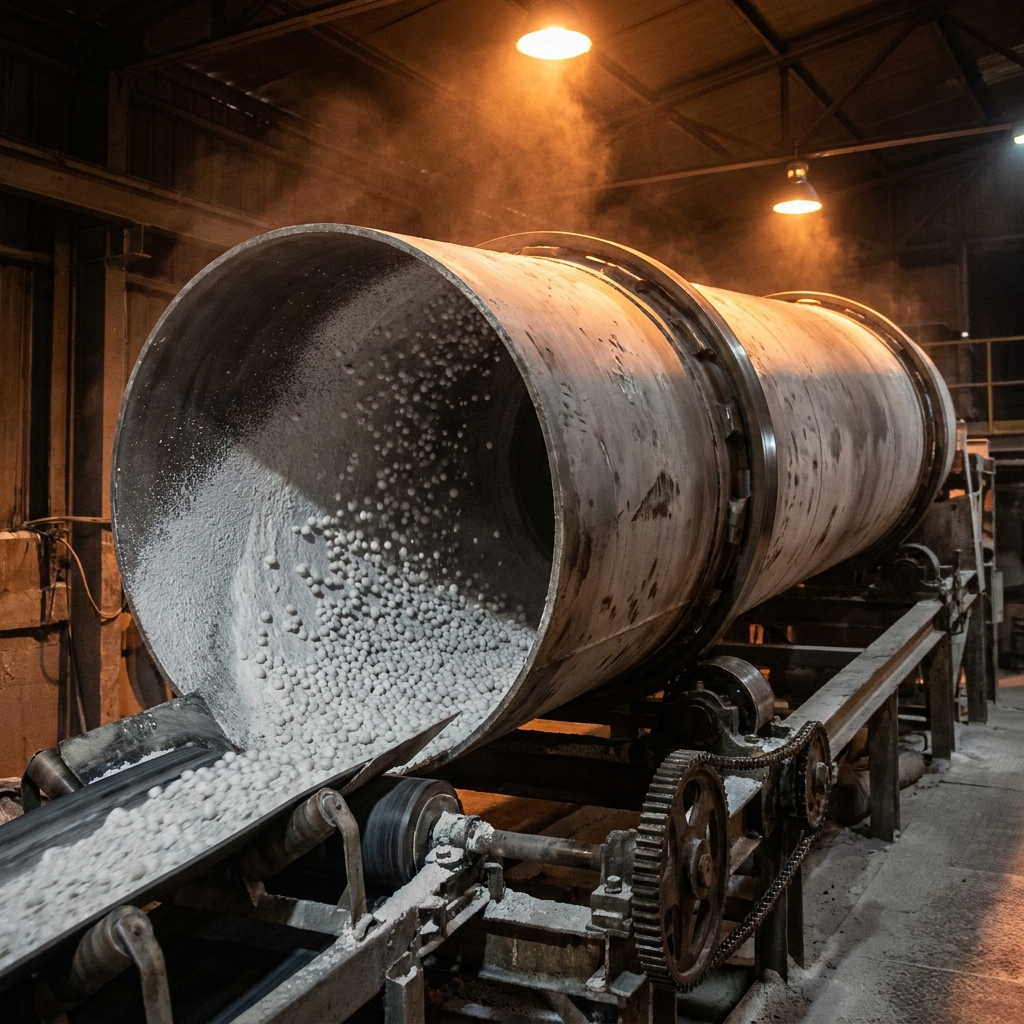
Rolling is used for zirconia grinding beads production because it continuously tumbles ceramic seed cores with binder spray and powder to build smooth, layered spheres efficiently. This versatile granulation method produces medium-sized Zirconia Grinding Beads ranging from 0.1 mm to 15 mm with excellent roundness. By adjusting pan rotation speed and moisture delivery, operators can scale production rapidly across broad media sizes.
How Does the Rotating Granulation Drum Work?
Industrial granulation drums rely on continuous centrifugal forces to accrete dry ceramic powder onto damp rotating seeds.
Think about it:
- Concentric Layering: Liquid spray forms adhesive surface tension that binds incoming sub-micron powder particles.
- Flexible Sizing: Operating duration directly controls the final diameter of growing ceramic spheres.
- Scalable Volume: Continuous tilt drums support large industrial batch outputs with low labor requirements.
Controlling liquid atomizer rates prevents over-wetting, which can cause misshapen agglomerates during tumbling. Precise angle adjustments keep the bead bed cascading evenly.
Key Takeaway: Granulation rolling offers exceptional size versatility and scalability, making it the most cost-effective method for mid-sized media.
| Drum Operating Parameter | Setting Range | Effect on Sphericity |
|---|---|---|
| Pan Tilt Angle | 40° – 55° | Governs tumbling trajectory and spherical growth |
| Rotation Speed | 20 – 45 RPM | Prevents sliding or violent particle breakage |
| Binder Atomization | 0.2 – 0.5 L/min | Eliminates clumping and uneven shell growth |
Systematic tuning of drum speed and liquid atomization maintains spherical symmetry during continuous powder accretion.
How Does Isostatic Pressing Improve Zirconia Grinding Beads?
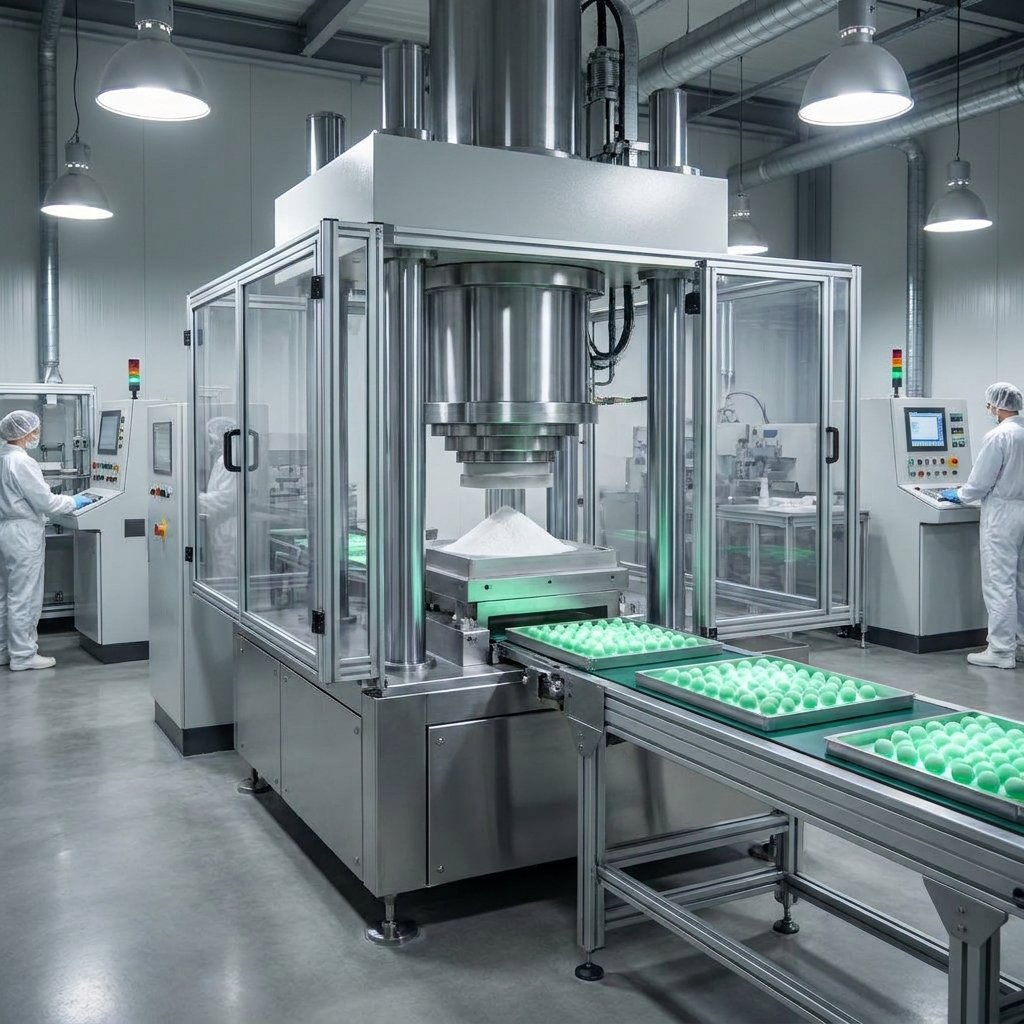
Isostatic pressing improves zirconia grinding beads by applying equal fluid pressure from all directions, eliminating internal density gradients and structural voids. Enclosing spray-dried powders inside flexible elastomer molds submerged in liquid pressure vessels allows green Zirconia Grinding Beads to reach maximum structural uniformity. This multi-directional pressure transmission prevents localized weak spots, drastically boosting fracture toughness in heavy-duty wet milling applications.
Is Cold Isostatic Pressing Better Than Die Pressing?
Cold isostatic pressing submerges flexible tooling into hydraulic liquid chambers, ensuring uniform pressure distribution across the entire bead surface.
Look:
- Zero Wall Friction: Eliminates shear stresses caused by rigid steel die walls during compaction.
- Homogeneous Core: Prevents low-density internal pockets that trigger premature media shattering.
- Isotropic Shrinkage: Ensures uniform dimensional contraction during high-temperature thermal sintering.
The hydraulic liquid cushion applies equal force to every square millimeter of the green body surface. Consequently, finished components display superior wear longevity under harsh shock loads.
Key Takeaway: Isostatic compaction guarantees uniform internal density, eliminating structural defects to yield maximum wear resistance in high-shear mills.
| Process Feature | Uniaxial Pressing | Cold Isostatic Pressing |
|---|---|---|
| Pressure Direction | Single/Dual Axis | Omnidirectional Hydrostatic |
| Internal Density | Variable Core | Completely Uniform |
| Crack Resistance | Moderate | Exceptional |
Omnidirectional hydraulic pressing eliminates internal stress risers, producing media capable of withstanding extreme mechanical impact.
How Does Dropping Form Micro Zirconia Grinding Beads?
Dropping forms micro zirconia grinding beads by atomizing liquid ceramic slurry into droplets that instantly gel into solid spheres inside a chemical bath. This sol-gel process is engineered for ultra-fine Zirconia Grinding Beads between 0.05 mm and 3 mm in diameter. Surface tension forces acting on liquid droplets naturally produce flawless roundness without surface tooling marks.

What Is the Sol-Gel Dropping Process?
The sol-gel dropping route combines liquid slurry jetting with ion-exchange gelation to produce uniform micro-beads without air pockets.
The best part?
- Zero Internal Porosity: Liquid slurry jetting eliminates air entrapment, producing 100% solid micro-spheres.
- Narrow Size Range: Precision nozzle vibration generates micro-droplets with extremely low diameter variance.
- Smooth Surface Finish: Surface tension creates smooth spherical exteriors prior to chemical fixation.
Maintaining stable slurry viscosity is crucial for preventing teardrop deformation as droplets enter the gelation bath. Modern automated jetting heads deliver steady production yields.
Key Takeaway: Sol-gel dropping provides pore-free micro-beads with perfect sphericity, essential for high-energy nano-milling applications.
| Dropping Factor | Target Range | Quality Contribution |
|---|---|---|
| Slurry Viscosity | 100 – 300 mPa·s | Controls droplet detachment and eliminates tails |
| Nozzle Frequency | 100 – 1000 Hz | Regulates precise droplet volume |
| Bath Concentration | 1.0% – 3.0% Salt | Fixes spherical geometry immediately |
Automated nozzle vibration combined with controlled slurry rheology delivers flawless micro-spheres with high structural density.
How Does Thermal Sintering Impact Zirconia Grinding Beads?
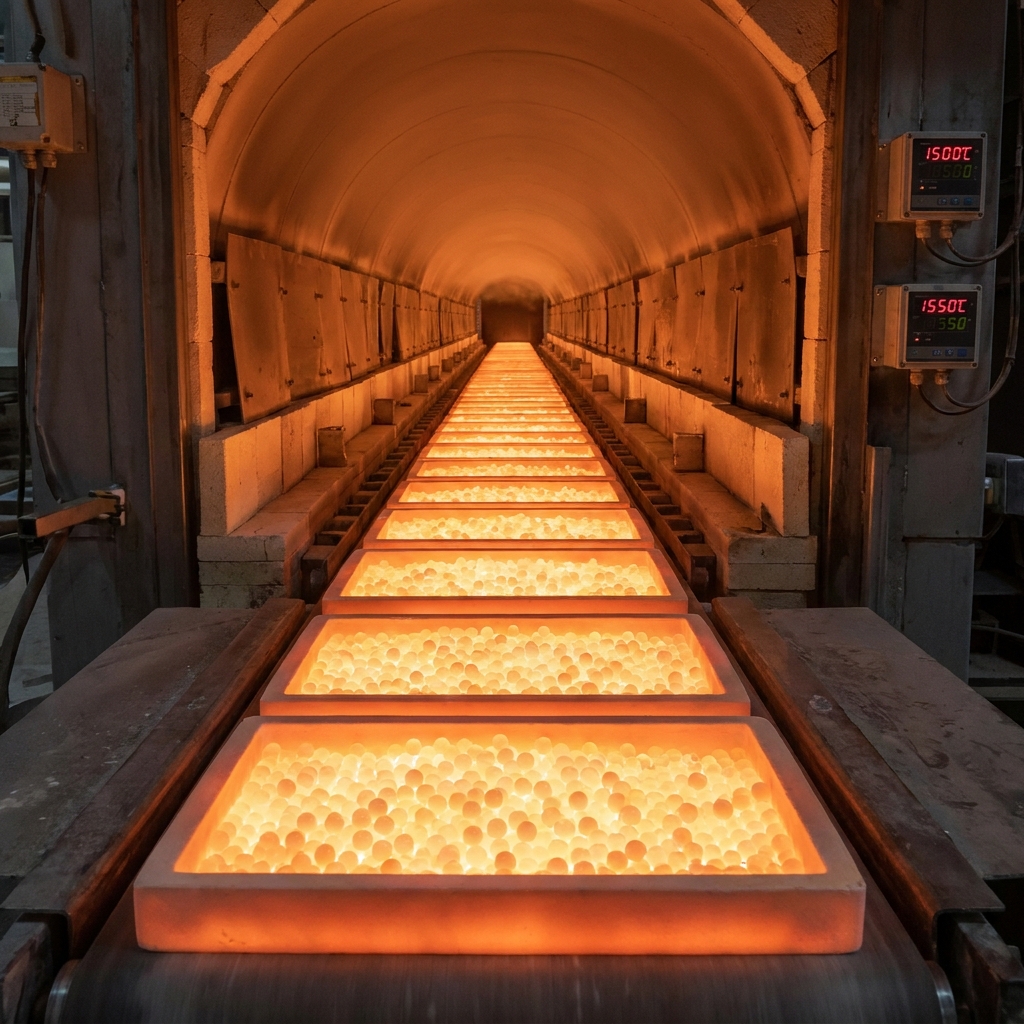
Thermal sintering impacts zirconia grinding beads by triggering solid-state atomic diffusion at 1400°C–1600°C, transforming green compacts into dense, wear-resistant crystalline bodies. Controlling thermal ramp rates and soak durations ensures that densified Zirconia Grinding Beads achieve near-theoretical density while preserving sub-micron crystal grains. Proper thermal processing locks in the metastable tetragonal phase necessary for phase-transformation toughening.
How to Optimize Sintering Temperature Ramps?
Optimizing temperature schedules requires controlled slow heating to burn off organic binders before initiating high-temperature densification.
In fact:
- Clean Binder Removal: Gradual thermal ramps prevent gas pressure spikes from cracking fragile green bodies.
- Grain Size Control: Controlled peak soak times restrict crystal grain growth below 0.5 microns.
- Phase Stabilization: Managed cooling prevents phase transformation into fragile monoclinic structures.
Thermal stress during rapid heating or cooling can induce microscopic thermal shock cracks. Maintaining steady temperature zones inside industrial tunnel kilns ensures microstructural consistency.
Key Takeaway: Precise thermal profiles lock in high density and sub-micron grain structures, maximizing fracture toughness and wear life.
| Sintering Phase | Temperature Range | Process Purpose |
|---|---|---|
| Binder Burnout | 200°C – 600°C | Removes organic additives without cracking |
| High-Temp Soak | 1400°C – 1600°C | Eliminates pores and achieves >99.5% density |
| Controlled Cooling | Peak to 800°C | Stabilizes tetragonal phase for toughness |
Restricting peak sintering temperatures protects sub-micron grain structures, boosting wear resistance during operation.
How to Inspect Quality in Zirconia Grinding Beads Batches?
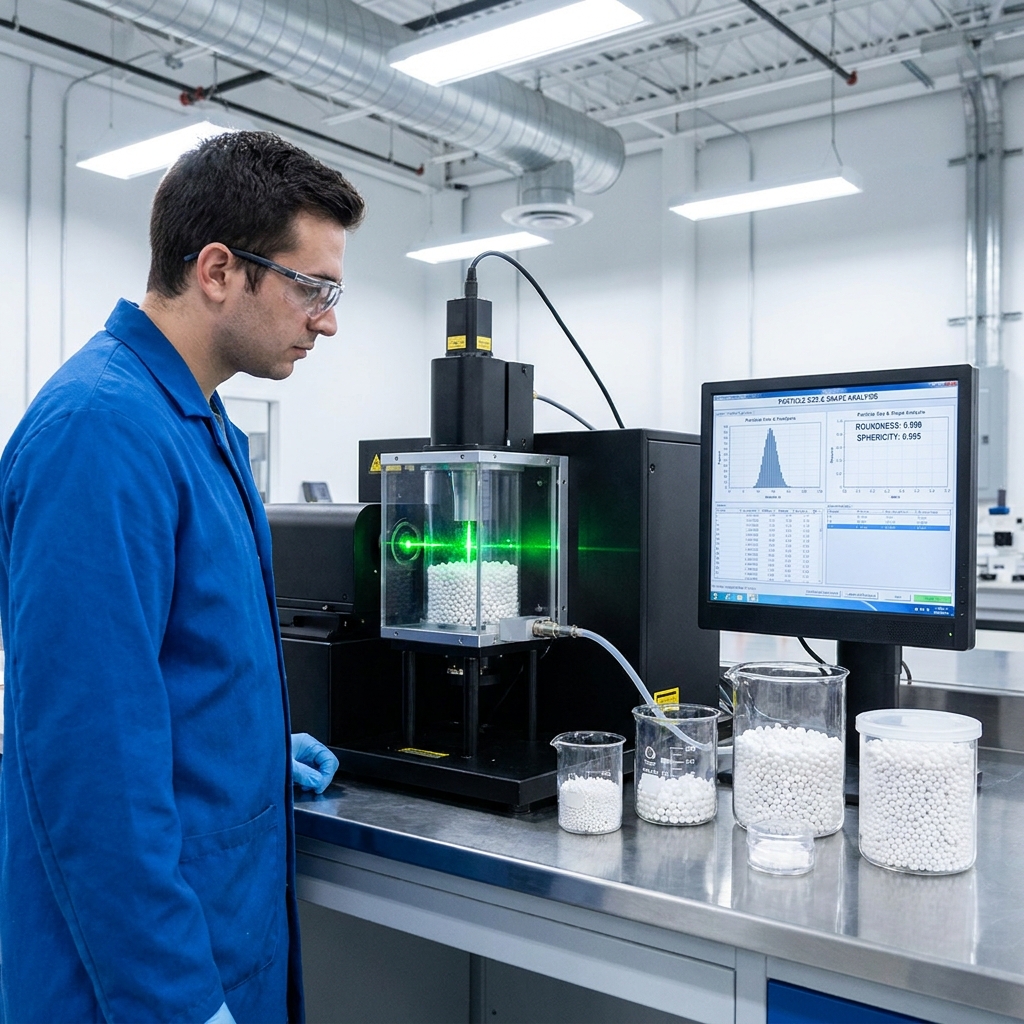
Quality in zirconia grinding beads batches is inspected by testing density, crush strength, chemical purity, and dimensional sphericity using automated optical and laboratory instruments. High-performance Zirconia Grinding Beads undergo multi-stage quality control checks to confirm compliance with stringent milling standards. Early detection of off-round beads or surface flaws prevents operational failures inside high-speed agitator mills.
Which Laboratory Tests Verify Bead Durability?
Laboratory verification measures bulk density, single-bead crush strength, and surface roughness across production samples.
Here is the truth:
- Density Verification: Pycnometer testing confirms theoretical density exceeds 6.0 g/cm³ for solid Y-TZP media.
- Crush Strength Load: Compression testing measures the fracture resistance of individual beads under load.
- Optical Sphericity: High-speed vision systems analyze thousands of beads to detect dimensional variance.
Inconsistent density signals hidden internal porosity, which leads to premature bead shattering under mechanical stress. Strict batch sampling protects downstream equipment from damage.
Key Takeaway: Comprehensive laboratory inspection verifies structural integrity and dimensional precision before media enters industrial service.
| Quality Test | Target Specification | Risk of Non-Compliance |
|---|---|---|
| Bulk Density | > 6.0 g/cm³ | Low density causes rapid wear and fracture |
| Crush Strength | > 2000 N (3mm bead) | Premature breakage under high agitation |
| Roundness Variance | < 2% Deviation | Uneven wear and mill screen blinding |
Rigorous quality verification eliminates defective beads, ensuring long service life and predictable grinding performance.
How Do Agitator Mills Use Zirconia Grinding Beads Efficiently?
Agitator mills use zirconia grinding beads efficiently by transferring rotational kinetic energy into intensive shear and impact forces that rapidly reduce particle sizes. Modern vertical and horizontal pin mills rely on dense Zirconia Grinding Beads to process high-viscosity slurries without media degradation. Matching bead size and packing density to mill rotor speed optimizes kinetic energy transfer across the grinding chamber.
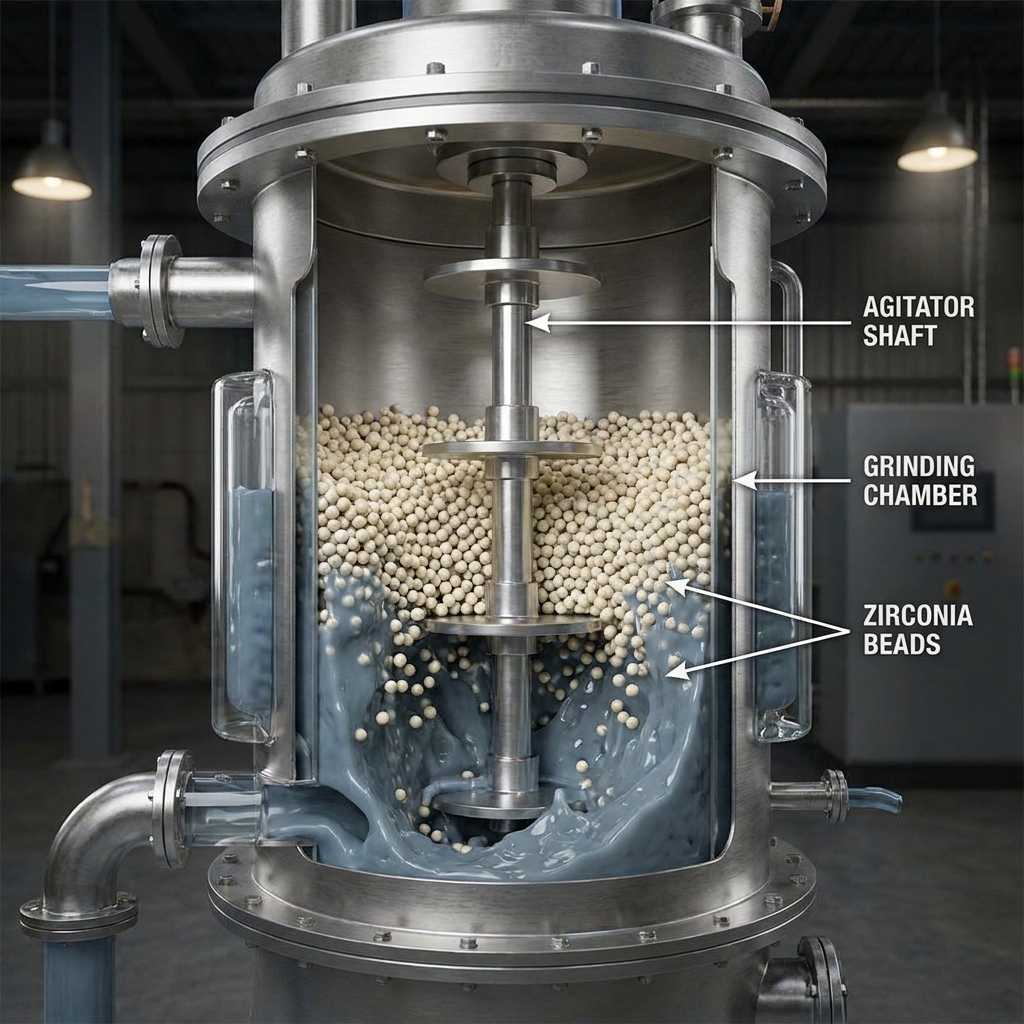
What Determines Kinetic Energy Transfer in Mills?
Kinetic energy transfer depends on media density, tip speed, and media charge volume within the grinding chamber.
Think about it:
- High Specific Gravity: Dense media deliver strong impact energy at lower rotor tip speeds.
- Optimized Charge Volume: Loading 70% to 85% chamber volume maximizes inter-bead friction and shearing action.
- Screen Compatibility: Selecting bead diameters larger than screen slot widths prevents hydraulic blinding.
Excessive rotor speeds increase media-to-media abrasion if slurry flow rates drop unexpectedly. Proper process monitoring maintains smooth slurry transport and protects media longevity.
Key Takeaway: Operating high-density ceramic media at optimal chamber fill ratios maximizes grinding throughput while minimizing energy consumption.
| Mill Parameter | Recommended Range | Operational Impact |
|---|---|---|
| Media Charge Volume | 70% – 85% Chamber | Maximizes shear density and grinding efficiency |
| Rotor Tip Speed | 8 – 14 m/s | Balances energy input against media wear rate |
| Bead-to-Screen Ratio | 3:1 Minimum Size | Prevents screen clogging and pressure spikes |
Optimizing mill rotor speed and bead fill ratios enhances kinetic energy delivery without increasing wear rates.
Why Does Microstructure Matter for Zirconia Grinding Beads?
Microstructure matters for zirconia grinding beads because fine, homogeneous grain structures absorb shock energy and prevent catastrophic crack propagation during high-shear dispersion. High-grade Zirconia Grinding Beads feature sub-micron grain boundaries stabilized by yttria, enabling phase-transformation toughening. When micro-cracks form, metastable tetragonal crystals transform into monoclinic phase, expanding locally to pinch cracks shut.
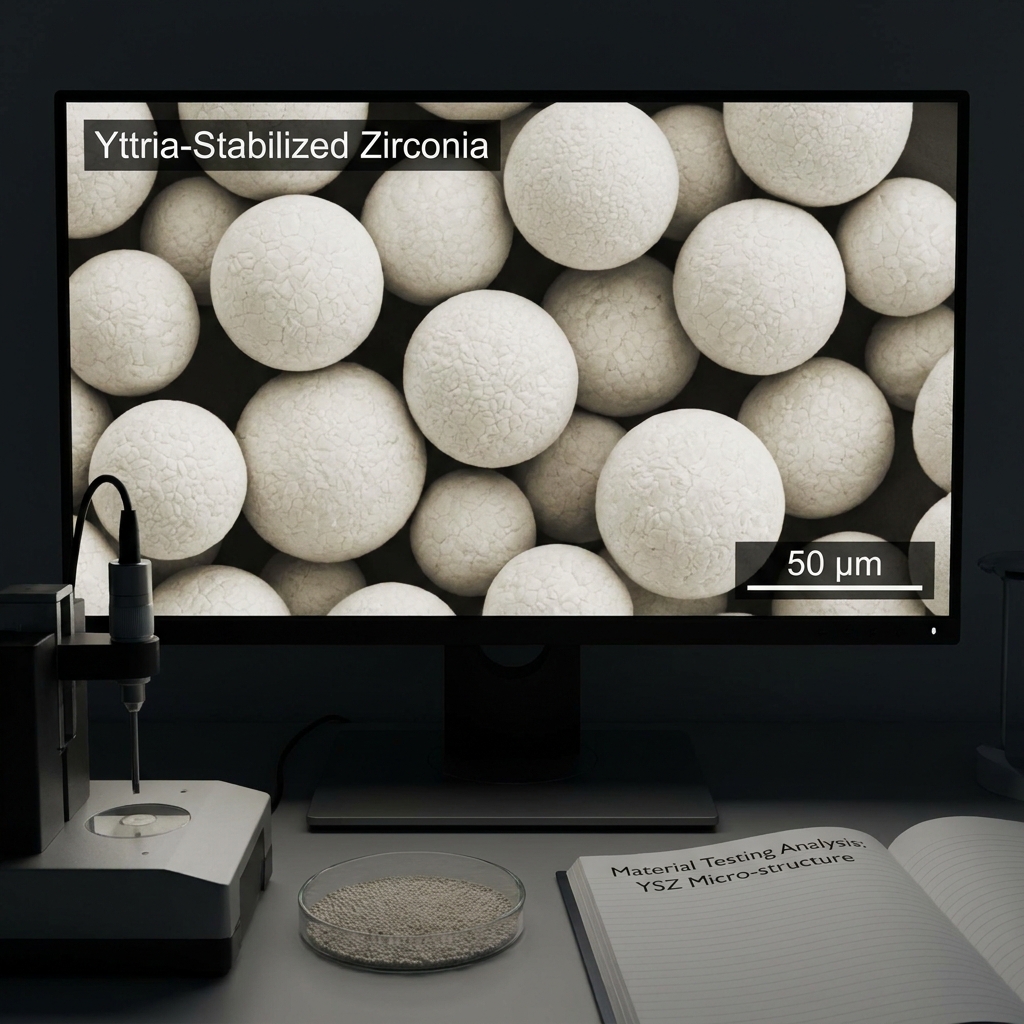
How Does Phase Transformation Toughening Work?
Phase-transformation toughening uses localized stress fields to trigger crystal expansion that halts crack progression in Y-TZP ceramics.
Look:
- Stress Absorption: Mechanical impact triggers local phase transformation from tetragonal to monoclinic geometry.
- Volume Expansion: The 3% to 5% crystal expansion creates compressive stress that seals micro-cracks.
- Wear Resistance: High lattice toughness resists micro-spallation under continuous sliding abrasion.
Coarse grain structures reduce transformation capability, making media vulnerable to sudden brittle fracture. Maintaining nanometer raw powders ensures fine microstructural boundaries.
Key Takeaway: Sub-micron grain structures unlock phase-transformation toughening, giving ceramic media exceptional impact toughness and durability.
| Microstructural Metric | Ideal Technical Value | Operational Benefit |
|---|---|---|
| Average Grain Size | < 0.5 µm | Higher hardness and transformation yield |
| Yttria Content | 3 mol% (5.15 wt%) | Stabilizes tetragonal crystal matrix |
| Internal Porosity | < 0.1% Volume | Prevents localized fracture initiation points |
Sub-micron tetragonal grain structures lock in self-healing transformation mechanics, extending media life in aggressive milling environments.
What Makes Cold Isostatic Zirconia Grinding Beads Superior?
Cold isostatic zirconia grinding beads are superior because omnidirectional hydrostatic compaction produces complete structural symmetry and zero internal density gradients. Heavy-duty wet milling processes utilize these cold-isostatically pressed Zirconia Grinding Beads to withstand high impact forces without spalling or fracturing. Their uniform density ensures predictable wear rates across thousands of operating hours.
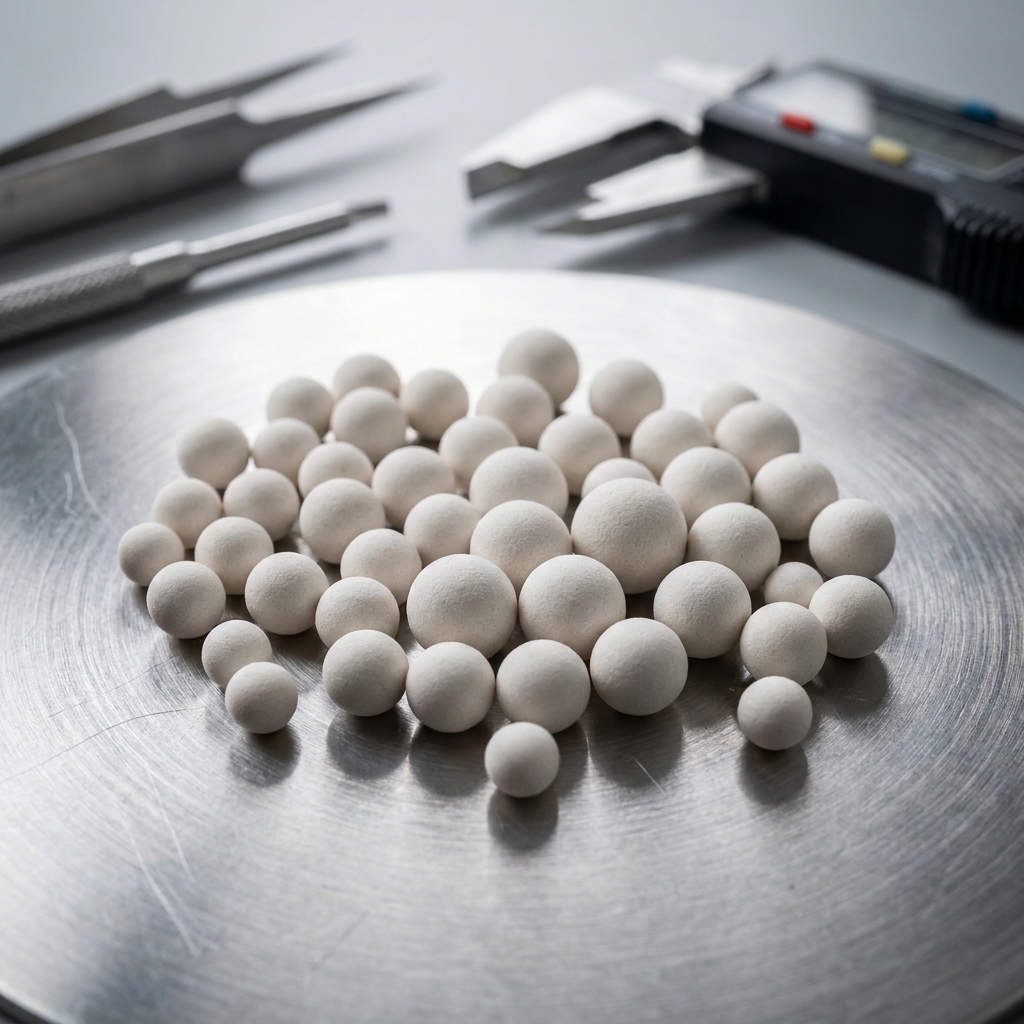
Why Choose Isostatic Media for Heavy Coarse Milling?
Isostatically pressed spherical media deliver maximum structural integrity required for large-diameter coarse grinding applications.
The best part?
- Zero Weak Planes: Equal fluid compaction prevents internal directional shear planes found in die pressing.
- Predictable Wear: Uniform internal density ensures consistent material removal rates across the entire media life.
- High Impact Energy: Robust core density allows larger beads (10 mm to 60 mm) to crush tough raw minerals.
Non-uniform green bodies shrink unevenly during sintering, creating oval shapes that degrade mill efficiency. Cold isostatic pressing guarantees perfect spherical balance after densification.
Key Takeaway: Cold isostatic forming yields uncompromised internal density, making it the top choice for demanding high-impact industrial milling.
| Performance Metric | Cold Isostatic Media | Standard Granulated Media |
|---|---|---|
| Internal Density | 100% Homogeneous | Moderate Gradient |
| Fracture Toughness | 8 – 10 MPa·m¹/² | 5 – 7 MPa·m¹/² |
| Operational Wear Rate | Ultra-Low | Moderate |
Omnidirectional compaction eliminates internal density voids, providing unparalleled resistance to impact-induced media failure.
How to Detect Defects in Zirconia Grinding Beads Early?
Defects in zirconia grinding beads are detected early by combining automated optical sorting, dye penetrant inspection, and ultrasonic density screening during production. Catching structural flaws before shipping prevents non-conforming Zirconia Grinding Beads from entering industrial wet mills. Identifying surface micro-cracks or internal voids guarantees that only pristine media reach customer facilities.
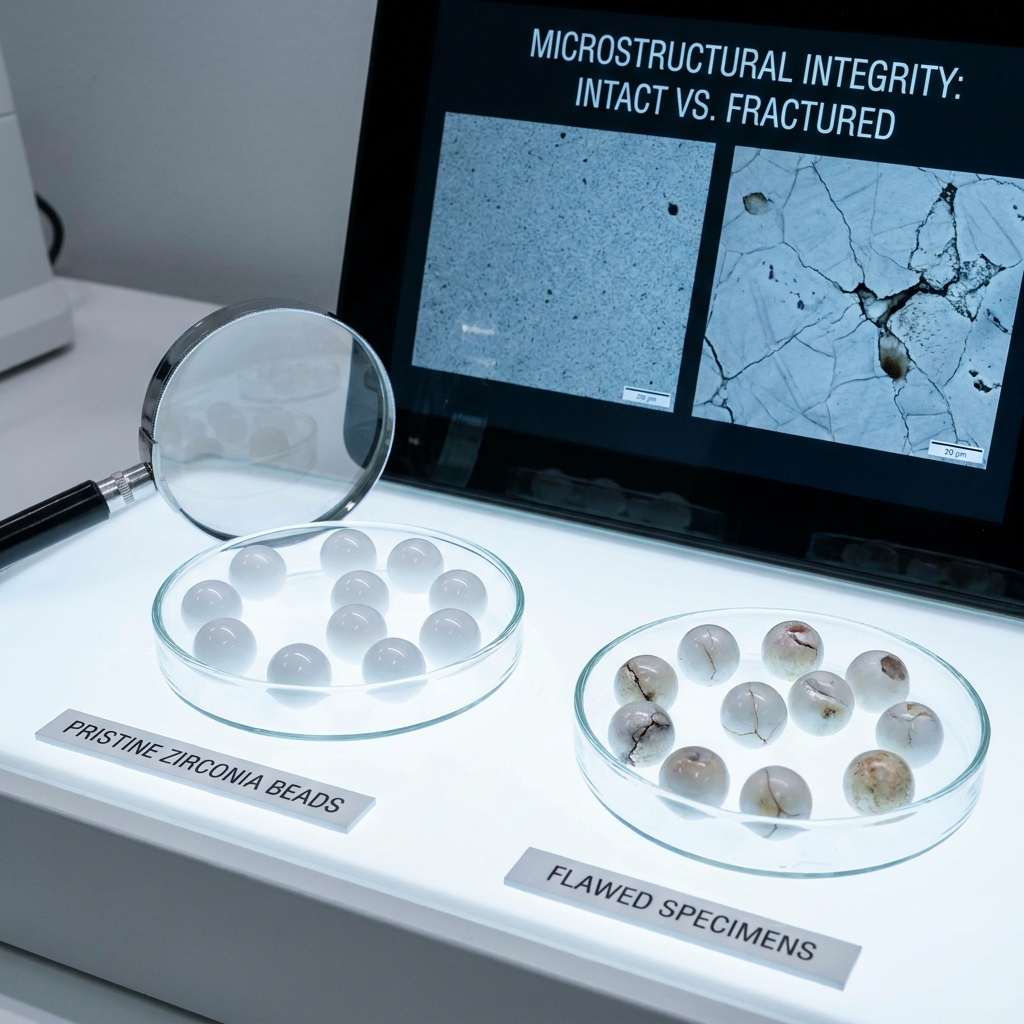
What Are the Most Common Media Defects?
Common defects include hollow cores, surface crazing, micro-cracks, and teardrop shapes caused by improper forming or thermal processing.
In fact:
- Hollow Cores: Rapid binder gelation or poor de-airing traps air pockets inside the bead core.
- Surface Crazing: Rapid thermal binder burnout creates gas pressure spikes that micro-fracture outer surfaces.
- Teardrop Shape: Inconsistent slurry viscosity during dropping distorts spherical geometry.
Optical laser scanners evaluate bead roundness at speeds exceeding thousands of units per minute. Removing defective pieces protects production lines from costly mill contamination.
Key Takeaway: Multi-stage inspection screens out flawed media early, ensuring maximum operational reliability and process purity.
| Defect Category | Primary Root Cause | Inspection Method |
|---|---|---|
| Internal Cavity | Entrapped slurry air | Ultrasonic / Density testing |
| Micro-Fissures | Rapid thermal ramp | Dye penetrant / Optical scan |
| Elliptical Shape | Improper drop viscosity | Automated vision sorter |
Early detection of geometric and structural defects ensures that only pristine, high-strength media reach industrial agitator mills.
Frequently Asked Questions
Can I use pressed zirconia grinding beads in high-speed agitator mills?
Yes, cold isostatically pressed zirconia grinding beads perform exceptionally well in high-speed agitator mills due to their high density and mechanical toughness. However, for micro-milling applications requiring sizes below 1.0 mm, titrated micro-beads are preferred to prevent mill screen blinding and ensure optimal liquid movement.
What’s the best forming method for sub-millimeter micro milling applications?
The dropping (titration) sol-gel method is the premier choice for sub-millimeter milling tasks. Dropping yields micro-spheres down to 0.05 mm with near-zero internal porosity, flawless sphericity, and exceptionally tight size distributions designed for precision nano-dispersion.
How do I know if rolling or dropping beads are better for paint dispersion?
Dropping beads are superior if your dispersion process requires sub-millimeter media (<1.0 mm) for maximum color strength and sub-micron particle reduction. Granulation rolling beads offer a highly cost-effective solution for standard paint formulations utilizing medium-sized media from 1.5 mm to 3.0 mm.
Can I re-sinter worn or damaged zirconia grinding beads?
Re-sintering worn or damaged zirconia media is generally not recommended because internal fatigue micro-cracks accumulated during milling cannot be cured by thermal treatment. Re-sintering damaged beads frequently causes catastrophic structural failure upon returning them to service.
How do I know if cold isostatic pressing is necessary for my process?
Cold isostatic pressing is necessary if your process operates under high mechanical impact loads or uses media larger than 5 mm that suffer from premature internal cracking. Hydrostatic compaction eliminates internal density gradients, providing the maximum structural toughness needed for heavy-duty milling.
Elevating Operational Longevity Through Advanced Media Engineering
Understanding how pressing, rolling, and dropping shape the density, roundness, and internal purity of zirconia grinding media empowers plant managers to eliminate premature media failure and optimize grinding output. Matching the exact forming method to your mill architecture, slurry viscosity, and particle size targets solves chronic contamination challenges while minimizing operational overhead.
ZrBrontec manufactures world-class ceramic grinding media tailored to demanding industrial dispersion applications. Our advanced material processing and strict quality assurance deliver unparalleled wear resistance and batch-to-batch consistency. To optimize your milling performance and lower maintenance costs, contact us today to consult with an engineering expert.