
Choosing the correct dental zirconia grade requires a precise balance of mechanical strength and optical translucency: use high-strength 3Y zirconia for heavy load-bearing posterior arches, highly translucent 5Y zirconia for high-aesthetic anterior restorations, and transitional 4Y zirconia as a versatile universal compromise. Dental labs and CAD/CAM centers constantly struggle with crown fractures or chalky, opaque aesthetics that lead to costly patient remakes. Stocking the wrong blanks or failing to match the material formulation to the precise clinical location can destroy your margins, wear down milling burs prematurely, and ruin your laboratory’s reputation with clinicians. Understanding the precise chemical and physical differences between 3Y, 4Y, and 5Y zirconia stabilization curves allows you to optimize your CAD/CAM workflows and clinical outcomes. By mastering these material properties, dental technicians can transition seamlessly from PFM frameworks to advanced monolithic dental ceramics using premium 3Y Zirconia and other stabilized grades.
Why is 3Y Zirconia the industry standard?
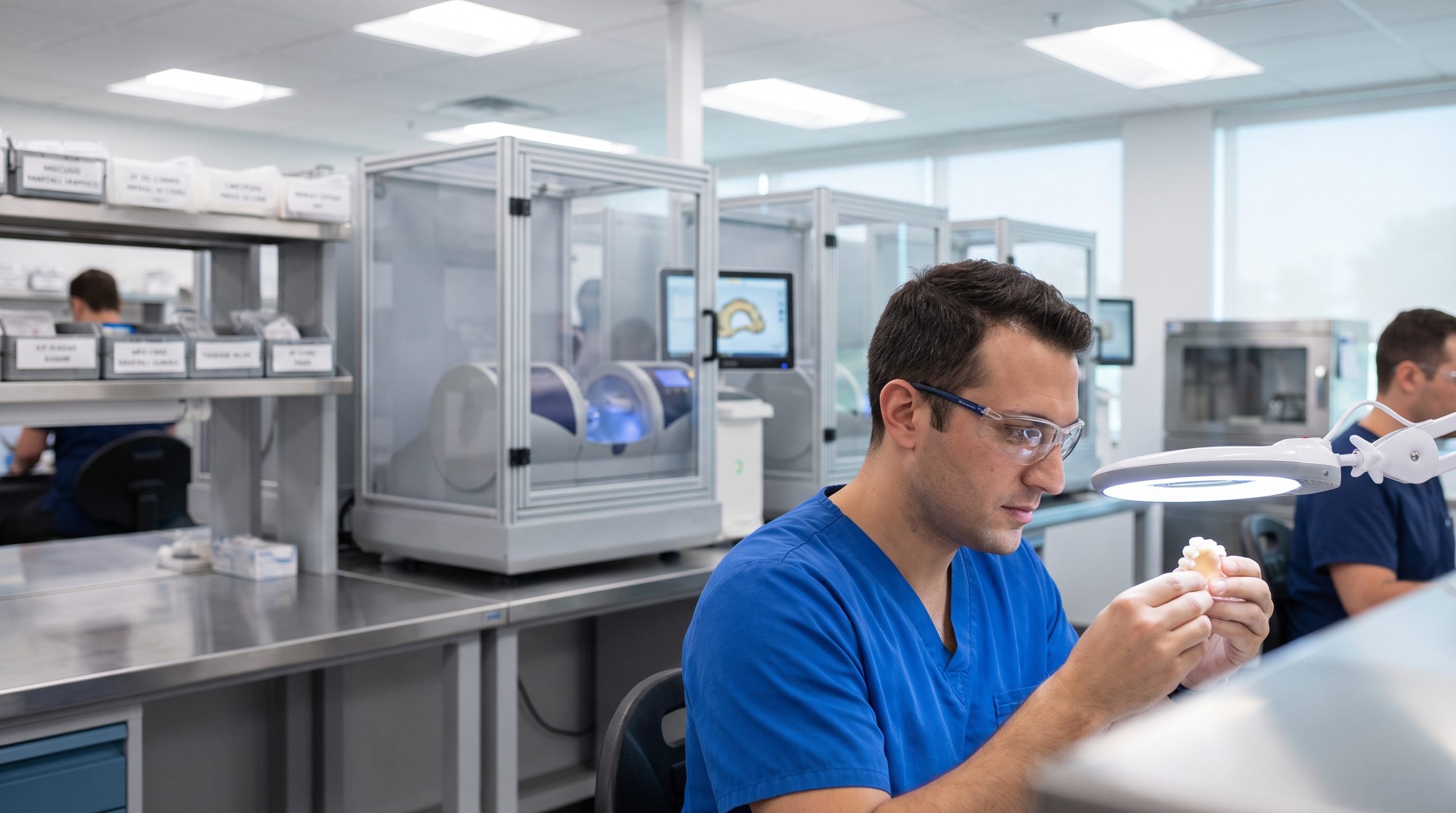
3Y zirconia remains the industry standard because its high tetragonal phase concentration delivers the unmatched mechanical toughness required for load-bearing restorations. This specific formulation of 3Y Zirconia prevents clinical failures and optimizes daily lab operations. Choosing this grade ensures that your finished crowns can survive the heavy chewing forces of posterior dental regions. It serves as the baseline material for dental laboratories aiming to deliver highly reliable results.
Transitioning your laboratory workflow to high-performance ceramics requires a deep understanding of structural stability. When you select your milling blanks, you must match the chemical composition to the exact clinical demands of the patient’s mouth. This proactive approach eliminates structural risk and maximizes crown longevity. Let’s analyze how this material maintains its dominance in modern CAD/CAM workflows.
How did dental ceramics evolve?
As you look back at the history of dental prosthetics, you will notice a massive shift away from porcelain-fused-to-metal restorations. Why does this matter? It is because metal-free alternatives have completely redefined patient expectations for aesthetics and durability.
Here is the deal:
- Traditional dental ceramics lacked the structural integrity to withstand posterior grinding.
- Unattractive gray margins frequently appeared at the gums when metal frameworks were used.
- Stabilized ceramic powders unlocked a brand-new era of metal-free clinical durability.
You can now produce beautiful, durable restorations that look and feel like natural teeth. By selecting high-purity stabilized powder, you protect your dental lab from costly remakes and client complaints. This evolution allows you to confidently handle complex posterior restorations. The mechanical shift has proven highly profitable for dental milling centers worldwide.
Can you balance strength and aesthetics?
To succeed in modern digital dentistry, you must constantly balance raw strength against aesthetic demands. But that is only the beginning… You will find that some materials sacrifice physical durability to achieve highly translucent results.
Consider this:
- High-strength restorations often look unappealingly chalky and opaque in the mouth.
- Extremely translucent materials are highly prone to fracture under high occlusal forces.
- Selecting the wrong disc thickness or preparation style will cause catastrophic crown failure.
Key Takeaway: You can dramatically reduce clinical remakes by using high-strength formulations for posterior bridges and transitioning to high-translucency options only in the anterior aesthetic zone.
| Grade Selection | Flexural Strength | Translucency Level | Primary Clinical Target |
|---|---|---|---|
| High-Strength Baseline | > 1,200 MPa | Low (35% – 38%) | Posterior multi-unit frameworks and heavy bruxers |
| Esthetic Champion | 600 – 800 MPa | High (49% – 53%) | Anterior single-unit crowns and delicate veneers |
Evaluating this baseline performance spectrum allows you to make precise, evidence-based material choices before initiating any CAD/CAM milling project.
How does 3Y Zirconia compare to other grades?
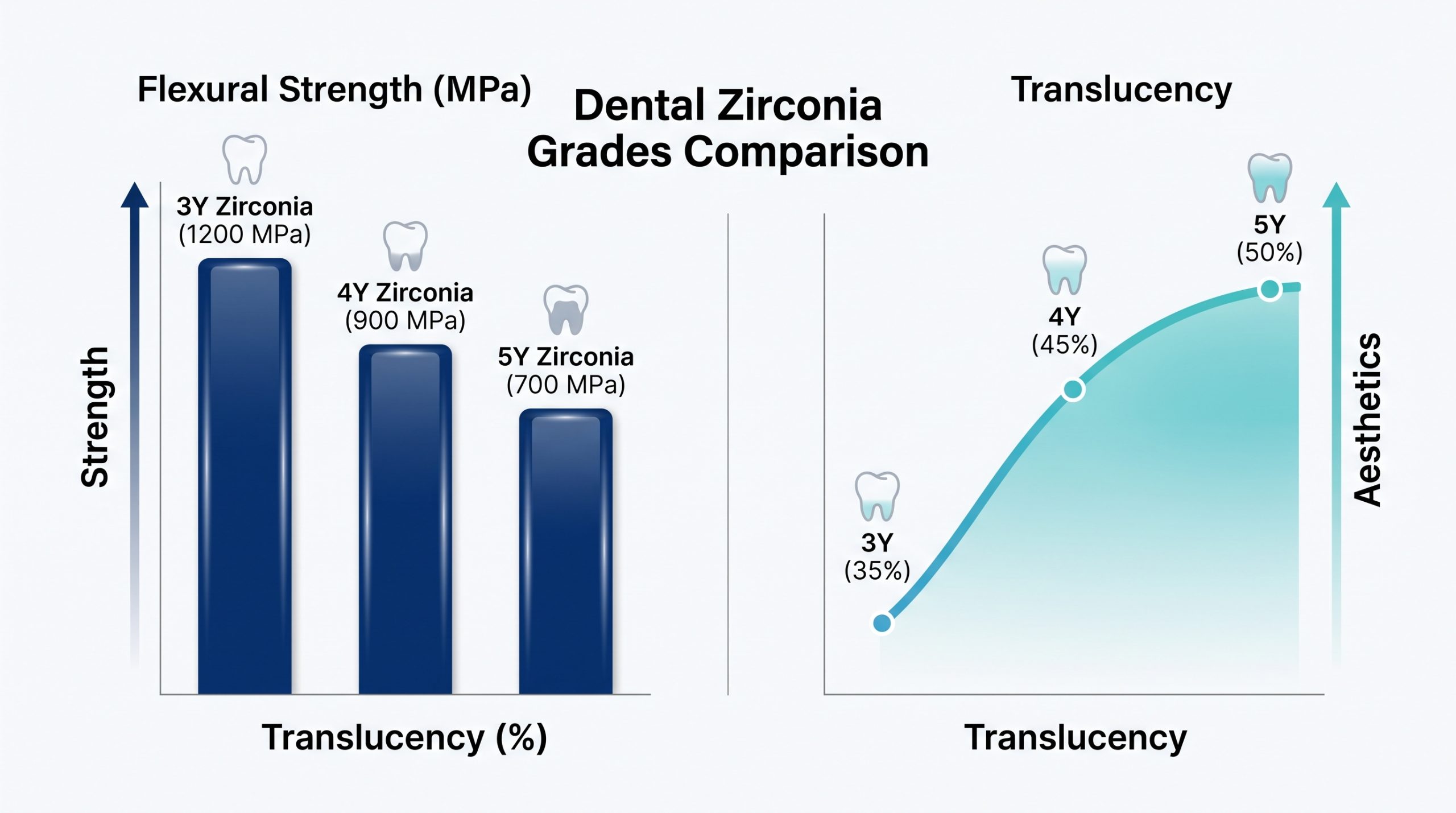
Comparing 3Y zirconia to 4Y and 5Y grades reveals a direct, inverse trade-off where mechanical strength decreases as yttria content increases to achieve greater light transmission. When you examine standard 3Y zirconia, you are looking at a material optimized for high-stress posterior applications. By contrast, the 4Y and 5Y grades introduce higher percentages of stabilizing yttria to alter the crystalline structure. This structural modification elevates the material’s aesthetic value while lowering its overall fracture resistance.
Understanding this chemical divergence is critical for dental technicians managing digital workflows. Choosing the wrong grade can lead to premature fractures or catastrophic failure of multi-unit restorations. You must master the performance boundaries of each category to achieve predictable results. Let’s delve into the exact yttria designations and their clinical implications.
What do the yttria percentage codes mean?
As you select dental blanks, you will encounter codes representing the mole percentage of yttria stabilization. Why does this matter? It is because these chemical ratios dictate the physical behavior of the sintered restoration.
Here is the deal:
- 3Y formulations contain approximately 3.0 mol% yttria to maintain a dominant tetragonal phase.
- 4Y materials use around 4.0 mol% yttria to establish a balanced crystalline blend.
- 5Y blocks feature roughly 5.0 mol% yttria, promoting a highly aesthetic cubic phase.
You will find that varying this chemical composition changes the way light passes through the material. By adjusting the yttria levels, manufacturers can manipulate both the translucency and the mechanical resilience. This chemical customization allows you to target highly specific patient requirements. Understanding these codes is your key to selecting the correct disc.
How does the strength-translucency trade-off work?
When you choose a zirconia grade, you must accept a clear physical trade-off between optical beauty and structural strength. But that is only the beginning… You will discover that as translucency levels rise, the material’s ability to resist cracking drops significantly.
Consider these factors:
- Raw flexural strength decreases steadily as you move from 3Y to 5Y.
- Light transmission increases dramatically with higher yttria concentrations.
- The risk of fracture under occlusal load rises when you prioritize aesthetics in posterior zones.
Key Takeaway: You should always prioritize 3Y formulations for high-stress posterior restorations, utilizing 5Y solely when aesthetic demands in the anterior region outweigh mechanical load concerns.
| Zirconia Grade | Yttria Content (mol%) | Average Flexural Strength | Average Translucency (%) |
|---|---|---|---|
| 3Y Grade | ~3.0 | 1,100 – 1,400 MPa | ~35% – 38% (Opaque) |
| 4Y Grade | ~4.0 | 850 – 1,100 MPa | ~43% – 47% (Semi-Translucent) |
| 5Y Grade | ~5.0 | 600 – 800 MPa | ~49% – 53% (High-Translucency) |
Reviewing these core parameters guarantees that you choose the most reliable blank for each unique clinical case.
What is the science behind 3Y Zirconia phases?
The science behind 3Y zirconia lies in its room-temperature stabilization of the tetragonal crystal phase, which triggers a self-healing transformation toughening mechanism under stress. This specific physical reaction is why 3Y Zirconia remains the ultimate choice for high-pressure dental restorations. When external force is applied, the local crystalline structure adapts to stop cracks from spreading. This atomic flexibility ensures that your finished crowns are incredibly tough and long-lasting.
Understanding these atomic phase changes helps dental technicians optimize their laboratory procedures. When you know how the material behaves under stress, you can prepare margins and design connectors with absolute confidence. This scientific foundation is critical for preventing catastrophic failures in the mouth. Let’s examine the specific phase shifts that make this ceramic so unique.
How does yttria stabilize zirconia phases?
As you study dental materials, you will learn that pure zirconia changes its crystal shape as it heats and cools. Why does this matter? Without stabilizing agents, the ceramic would shatter during the cooling process in your sintering furnace.
Here is the deal:
- Pure zirconia naturally forms a monoclinic structure at room temperature.
- Yttria additions stabilize the tetragonal phase under standard conditions.
- Cubic phases are formed at higher temperatures or with increased yttria content.
You can think of yttria as a chemical lock that keeps the crystals in a highly stable, high-strength state. By maintaining this tetragonal phase, you give the material its exceptional resistance to physical wear. This phase control is what makes advanced CAD/CAM ceramics possible for modern labs. It ensures that your restorations maintain their precise dimensions over time.
What is transformation toughening?
You can observe a fascinating self-healing property in high-strength dental ceramics called transformation toughening. But that is only the beginning… When a microscopic crack begins to form, the stress triggers an immediate structural shift in the surrounding crystals.
This process works as follows:
- Tetragonal crystals quickly transform into larger monoclinic shapes under localized stress.
- This transformation causes a localized volume expansion of approximately three to four percent.
- The resulting expansion squeezes the crack shut, preventing it from spreading further.
Key Takeaway: You can rely on the self-healing transformation toughening of tetragonal-heavy zirconia to safeguard your posterior restorations against slow fatigue cracking and unexpected clinical failures.
| Material Grade | Tetragonal Phase (%) | Cubic Phase (%) | Toughness Mechanism | Primary Failure Risk |
|---|---|---|---|---|
| 3Y Grade | ~85% – 90% | ~10% – 15% | High Transformation Toughening | Slow fatigue cracking |
| 4Y Grade | ~65% – 70% | ~30% – 35% | Moderate Crystalline Toughening | Combined impact fracture |
| 5Y Grade | ~45% – 50% | ~50% – 55% | Minimal Toughening (Brittle) | Sudden catastrophic snap |
Analyzing this crystalline phase distribution highlights why high-tetragonal blanks are indispensable for long-span posterior frameworks.
Why is 3Y Zirconia called the strength king?
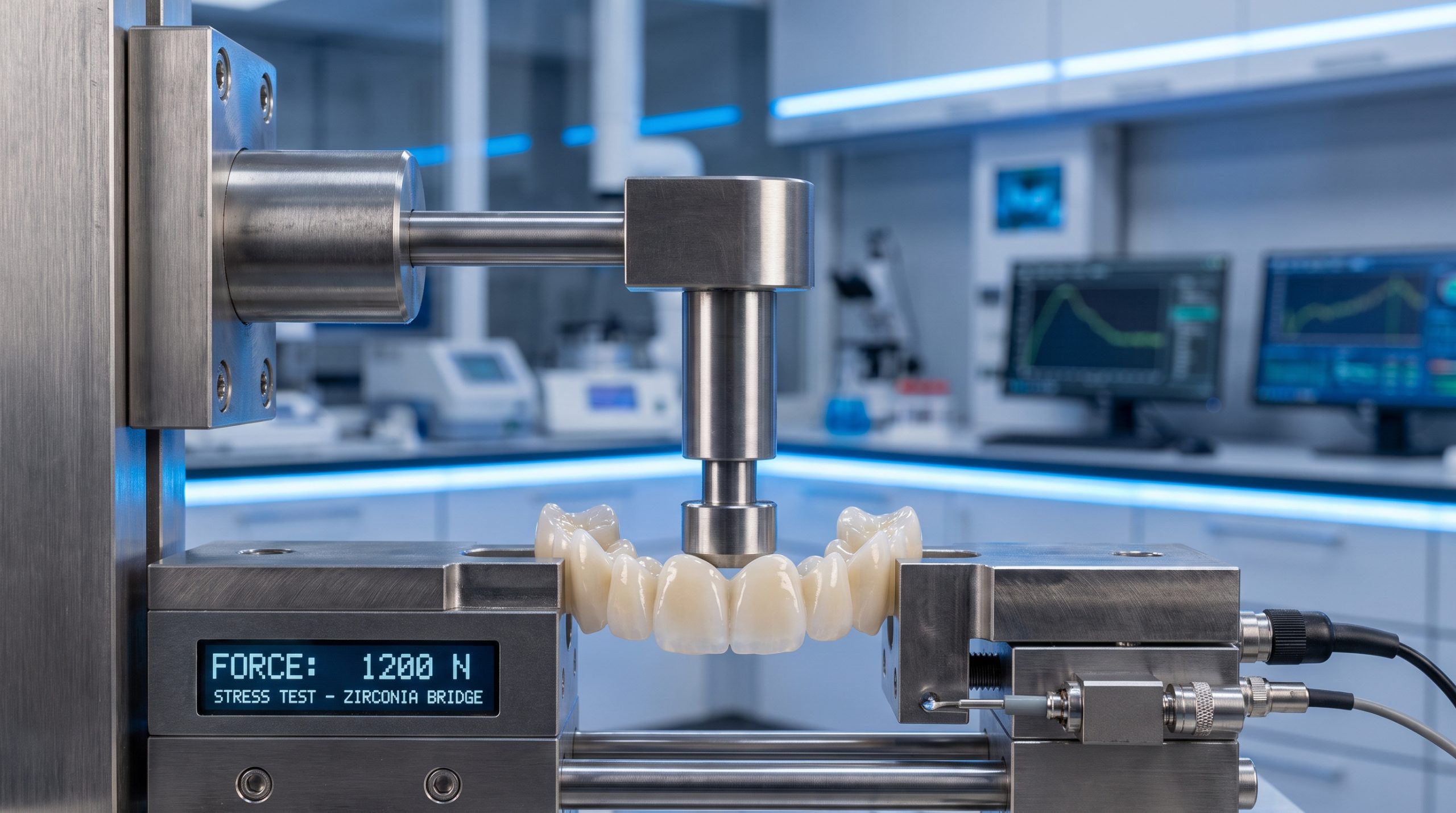
3Y zirconia is crowned the strength king because its flexural strength exceeds 1,200 MPa, allowing it to withstand extreme posterior occlusal forces. This incredible durability makes standard 3Y zirconia the absolute benchmark for demanding restorations that must endure heavy chewing loads. When you are milling crowns for patients with severe bruxism, this material provides the ultimate insurance policy against fracture. It is a highly reliable material that has proven its clinical success over decades of use.
Choosing a material with this level of mechanical support allows you to design thinner restoration walls safely. This means dentists can preserve more of the patient’s natural tooth structure during the preparation process. It is a win-win situation for both the clinician and the dental laboratory. Let’s examine the physical performance metrics that establish this material’s dominant position.
What are the limits of its flexural strength?
When you evaluate the mechanical limits of dental ceramics, you will find that high-strength zirconia outperforms all traditional options. Why does this matter? It is because posterior restorations are subjected to massive forces that would instantly destroy glass-ceramics.
Consider these mechanical values:
- Its flexural strength easily surpasses 1,200 MPa and can reach up to 1,400 MPa.
- Its high fracture toughness value prevents cracks from spreading under heavy loads.
- Its high hardness score ensures long-term wear resistance against opposing teeth.
You can design incredibly thin copings and crowns without worrying about physical failure during clinical use. This high strength also provides excellent edge stability, which keeps your margins sharp and intact during CAD/CAM milling. By utilizing these robust blanks, you improve your laboratory’s manufacturing yield and reduce waste. This mechanical reliability is crucial for your business success.
Where are the primary high-stress zones?
You should always identify the high-stress zones in the mouth before selecting your milling materials. But that is only the beginning… You will find that posterior load-bearing regions and multi-unit bridge spans present the highest risk of mechanical failure.
Key clinical areas include:
- Posterior molar zones where bite pressures reach their maximum levels.
- Long-span bridge connectors where tensile forces can cause material snapping.
- Full-arch implant-supported frameworks that require maximum structural rigidity.
Key Takeaway: You must utilize ultra-high-strength 3Y material for any long-span posterior bridges or full-arch frameworks to ensure the restoration can withstand the maximum forces of human mastication.
| Mechanical Property | 3Y Grade Specs | 4Y Grade Specs | 5Y Grade Specs | Safe Clinical Target |
|---|---|---|---|---|
| Flexural Strength | 1,200 – 1,400 MPa | 850 – 1,100 MPa | 600 – 800 MPa | > 800 MPa (bridges) |
| Fracture Toughness | 5.0 – 8.0 K₁c | 3.5 – 4.5 K₁c | 2.2 – 3.0 K₁c | > 3.5 K₁c (minimum) |
| Vickers Hardness | ~1,250 HV10 | ~1,200 HV10 | ~1,150 HV10 | ~1,200 HV10 (standard) |
Reviewing these physical metrics proves that high-strength zirconia remains the only viable choice for complex, multi-unit restorations.
How does 5Y stack up against 3Y Zirconia?
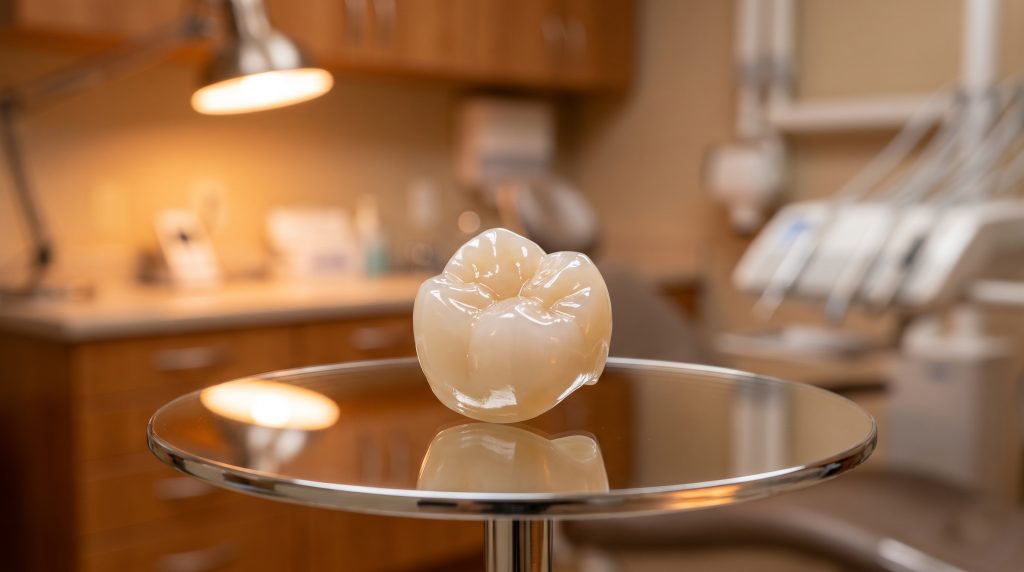
Comparing 5Y zirconia to 3Y zirconia highlights a complete shift from raw mechanical endurance to highly translucent, glass-like anterior aesthetics. When you choose a premium 3Y Zirconia blank, you are prioritizing raw strength over natural beauty. By contrast, 5Y zirconia incorporates a higher concentration of stabilizing yttria to generate a large volume of cubic crystals. These larger, symmetrical crystals do not scatter light, resulting in a beautiful, translucent finish that mimics natural tooth enamel.
This dramatic increase in light transmission makes 5Y the ideal candidate for delicate front-tooth restorations. However, you must remember that this aesthetic upgrade comes with a significant drop in physical durability. Technicians must understand these performance limits to avoid putting beautiful but weak crowns in high-stress posterior areas. Let’s look closer at how you can utilize this high-translucency option safely.
Is 5Y the best choice for front teeth?
When you are working in the anterior aesthetic zone, matching adjacent natural teeth is your most important goal. Why does this matter? It is because front-tooth restorations are highly visible, and an opaque, chalky-looking crown will immediately ruin a patient’s smile.
Here is the deal:
- 5Y material allows more light to pass through, avoiding an artificial appearance.
- It blends seamlessly with natural enamel and dentin shades.
- It is perfect for thin anterior crowns, veneers, and cosmetic cases.
You can achieve stunning, life-like results without needing to apply complex porcelain layers by hand. This monolithic approach saves you valuable laboratory processing time while maintaining a very high standard of aesthetics. By choosing high-translucency blanks for your anterior cases, you make patients happy and reduce hand-staining steps. It is the ultimate tool for high-end cosmetic dental labs.
What are the risks of lower strength?
You must recognize that 5Y’s beautiful appearance comes with a significant sacrifice in mechanical resistance. But that is only the beginning… You will find that its flexural strength is roughly half that of standard high-strength blanks.
Be aware of these structural limits:
- It does not undergo transformation toughening, making it brittle.
- It is highly prone to unexpected fracturing if used for posterior bridges.
- It requires much larger connector dimensions to prevent clinical failure.
Key Takeaway: You should reserve highly translucent 5Y formulations exclusively for single-unit anterior crowns and veneers, where natural aesthetics are the primary requirement and mechanical forces are minimal.
| Selection Factor | 3Y Grade (Strength Focus) | 5Y Grade (Aesthetic Focus) | Direct Lab Impact |
|---|---|---|---|
| Light Translucency | 35% – 38% | 49% – 53% | Determines how well restoration blends with natural teeth |
| Minimum Connector Size | $7\text{ mm}^2$ (Posterior) | $12\text{ mm}^2$ (strictly Anterior) | Dictates the spacing and preparation space required |
| Veneering Requirement | Often requires hand-applied porcelain | Designed for simple monolithic stain & glaze | Affects overall lab labor hours and throughput speed |
Reviewing these fundamental differences ensures that you never compromise structural safety for the sake of cosmetic appeal.
Is 4Y a good compromise for 3Y Zirconia?
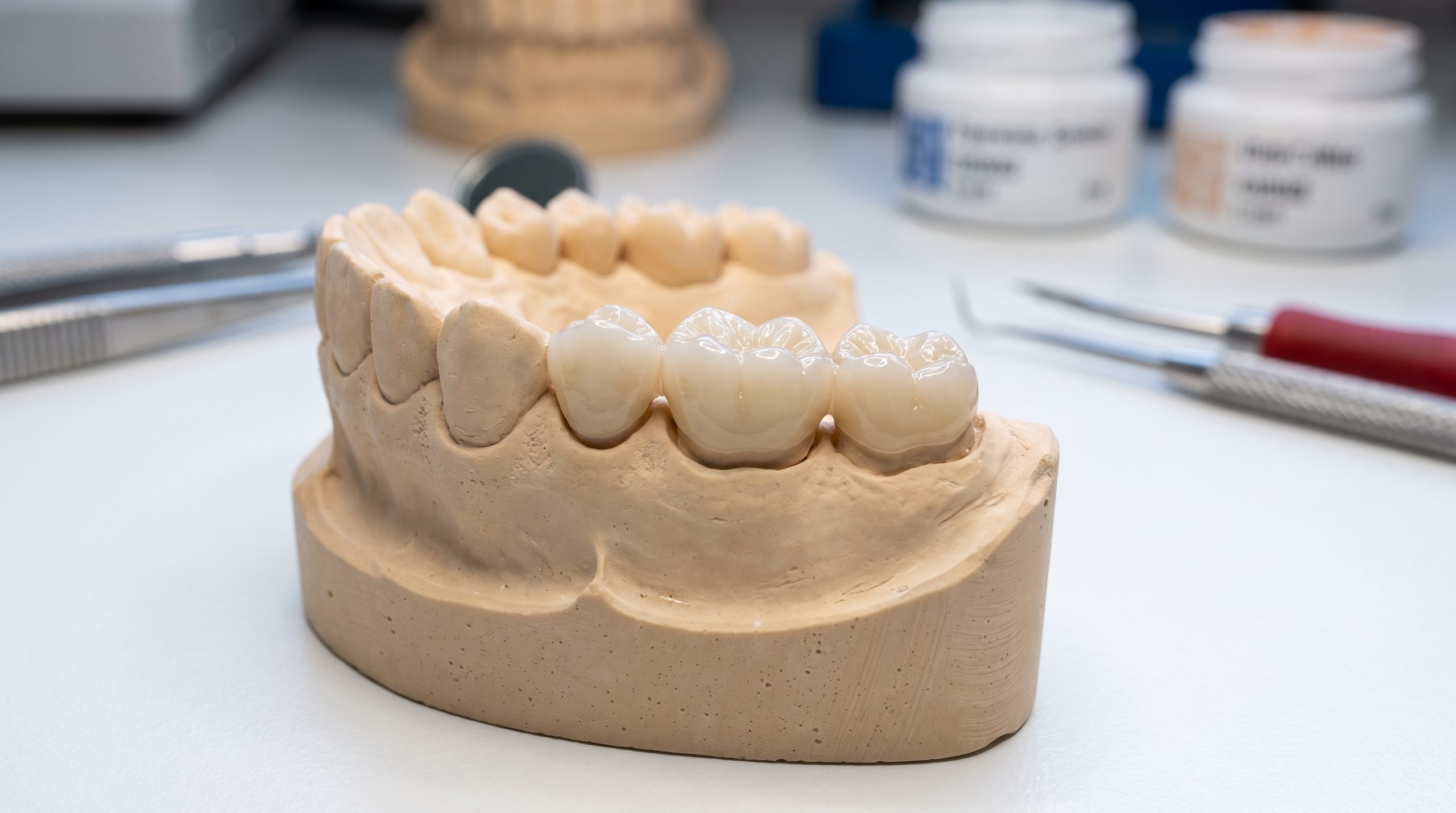
4Y zirconia serves as an outstanding intermediate compromise by offering a balanced blend of semi-translucent aesthetics and robust structural integrity. While standard 3Y zirconia remains the benchmark for pure strength, it can sometimes look slightly too opaque for monolithic posterior crowns. The development of 4Y formulations allows you to bridge this performance gap effectively. It provides dental labs with a highly versatile, single-blank solution for everyday cases.
Using a high-performance universal material helps you simplify your disc inventory and reduce waste. You can mill both anterior and posterior single-unit restorations from the same block without compromising on safety or beauty. This operational efficiency is highly valuable for busy CAD/CAM centers. Let’s explore how this balanced material performs in clinical applications.
Why are universal materials so popular?
As you manage your dental lab’s inventory, you will quickly see the benefits of stocking universal monolithic blocks. Why does this matter? It is because managing dozens of different highly specialized blanks increases your overhead costs and leads to production delays.
Universal blocks help you:
- Reduce the total number of specialized discs you need to keep in stock.
- Speed up your CAD/CAM nesting process by grouping different cases together.
- Deliver consistent, highly predictable results for your everyday dental cases.
You can comfortably use this balanced grade for the vast majority of crowns that come through your facility. By establishing a reliable universal workflow, you minimize human error during the nesting and sintering stages. This standardization improves your overall laboratory efficiency and increases your profit margins. It is a highly practical strategy for modern CAD/CAM operations.
Can you use 4Y for multi-unit bridges?
You can safely use 4Y materials for short-span bridges, provided you pay close attention to preparation guidelines. But that is only the beginning… You must ensure that you maintain proper connector sizes and avoid using it for long-span posterior structures.
Important design rules include:
- Limit your bridge designs to a maximum of three structural units.
- Ensure that posterior connector areas are designed with sufficient thickness.
- Avoid prescribing this intermediate grade for patients with heavy bruxism.
Key Takeaway: You can safely utilize 4Y zirconia as a universal material for single crowns and three-unit bridges, streamlining your laboratory inventory without sacrificing patient safety.
| Indication Type | 3Y Zirconia | 4Y Zirconia | 5Y Zirconia | Clinical Design Rule for 4Y |
|---|---|---|---|---|
| Maximum Span | Unlimited | Up to 3 units | Single units only | Restrict to 3-unit short spans |
| Minimum Wall Thickness | 0.4 mm | 0.6 mm | 0.8 mm | Maintain at least 0.6 mm thickness |
| Posterior Aesthetics | Moderate (stain/glaze) | High (monolithic) | Very High (unnecessary) | Excellent for monolithic back teeth |
Reviewing these clinical limits helps you implement a reliable, simplified material strategy across all digital production lines.
How do multilayer discs use 3Y Zirconia?
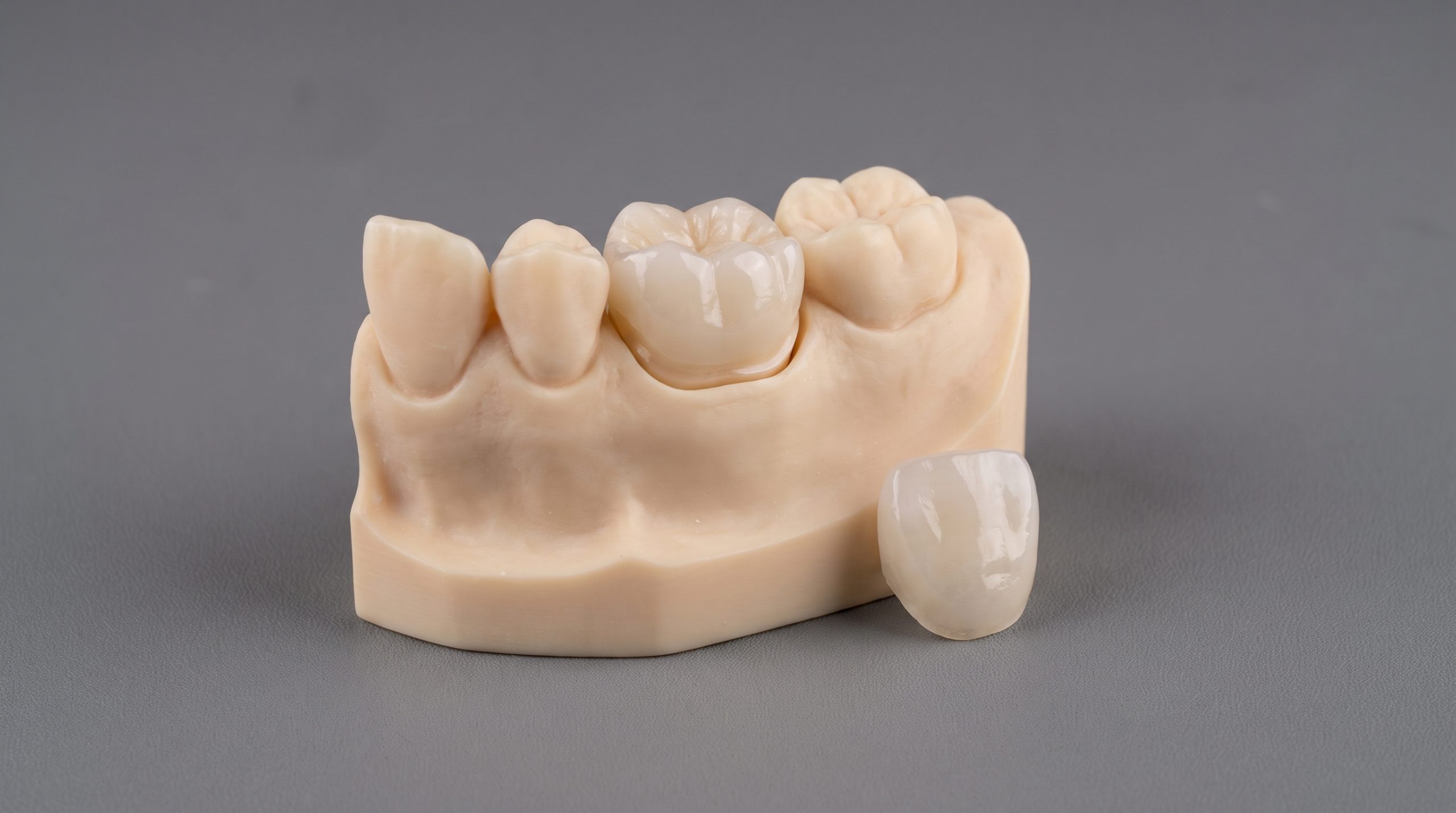
Multilayer discs leverage 3Y zirconia as a high-strength cervical base layer that smoothly transitions into more aesthetic grades toward the translucent incisal edge. This multi-grade formulation allows you to achieve a beautiful gradient of shade and strength in a single restoration. By incorporating 3Y Zirconia at the neck of the crown, the material ensures high load-bearing capacity where bite forces are concentrated. It is a highly advanced engineering solution that addresses both mechanical and aesthetic dental demands.
Understanding how these multi-layered zones are structured helps you position your designs perfectly inside the CAD/CAM software. When you nest your crown correctly, you align the strongest material with the margins and the highly translucent material with the biting edges. This smart layout optimizes both restoration longevity and patient satisfaction. Let’s analyze how this gradient technology works to improve your laboratory outputs.
How are yttria gradients created?
As you inspect a modern multi-grade disc, you will find a highly sophisticated transition of material properties from top to bottom. Why does this matter? It is because natural human teeth are not uniform in either color or structural strength.
The graded layers consist of:
- A strong cervical base zone composed of high-toughness 3Y material.
- An intermediate transition zone that blends 3Y and 4Y powders together.
- A highly translucent incisal top layer featuring aesthetic 5Y formulation.
You can achieve an incredibly natural transition of both shade and light transmission without manual powder buildup. This automated gradient technology mimics natural dentin and enamel structures beautifully during the final sintering process. By using these advanced discs, you eliminate the risk of delamination between different material layers. It is a highly reliable way to produce gorgeous, monolithic restorations.
Does this prevent edge chipping?
You will find that multi-grade designs offer outstanding edge stability during both milling and clinical function. But that is only the beginning… This layered approach puts maximum toughness right at the thin, delicate crown margins where chipping is most likely to occur.
This protective layout provides:
- High mechanical strength at the margin to prevent fracture under load.
- A slightly softer incisal zone that is highly gentle on opposing natural teeth.
- Excellent edge stability that maintains clean, sharp margins throughout the milling cycle.
Key Takeaway: You should adopt multi-grade blank technology to automatically combine high cervical margin strength with lifelike incisal translucency in a single, high-efficiency milling cycle.
| Disc Section | Localized Material | Localized Strength | Localized Translucency | Primary Functional Benefit |
|---|---|---|---|---|
| Incisal (Top 20%) | 5Y Formulation | ~600 – 750 MPa | ~49% – 52% | Natural translucent aesthetics at biting edge |
| Transition (Mid 30%) | 4Y Blend | ~900 – 1,000 MPa | ~43% – 46% | Smooth gradient transition of shade and strength |
| Cervical (Base 50%) | 3Y Formulation | ~1,100 – 1,300 MPa | ~35% – 38% | Maximum load resistance at thin margin areas |
Analyzing this internal layer composition explains how graded blocks achieve both clinical safety and premium cosmetic integration.
How does 3Y Zirconia impact lab milling?

3Y zirconia impacts lab milling by providing exceptional edge stability that prevents marginal chipping during high-speed wet or dry CAD/CAM operations. This structural toughness is a major benefit when you are processing delicate margin designs on complex molar preparations. Because pre-sintered 3Y zirconia is dense and stable, it holds its shape perfectly without cracking under the pressure of the milling burs. This high stability means you can count on highly accurate restorations that fit the dentist’s preparations perfectly.
However, to achieve these pristine results consistently, you must maintain your milling equipment and monitor bur wear closely. Harder, high-density blocks can accelerate the wear rate of your diamond-coated tools if your parameters are not optimized. By matching your CAD/CAM settings to the specific density of your blanks, you protect your equipment and reduce operating costs. Let’s look at how you can optimize your digital milling strategy for these strong ceramics.
How can you protect your milling tools?
As you process strong ceramic blanks in your laboratory, you must take active steps to extend the lifespan of your milling burs. Why does this matter? It is because premature bur wear increases your production costs and can cause micro-fractures along your margins.
To protect your tools, you must:
- Use premium diamond-coated burs specifically designed for pre-sintered ceramics.
- Maintain exact spindle calibration and follow the manufacturer’s recommended feed rates.
- Monitor tool wear indicators within your CAD/CAM software to replace burs on time.
You will find that taking these simple precautions dramatically reduces margin chipping and surface defects on your restorations. By standardizing your tool-replacement cycles, you ensure that every crown is milled under optimal physical conditions. This proactive approach saves you money on raw materials and prevents unexpected production downtime. It is an essential practice for high-volume dental labs.
Why is predictability critical?
You must maintain strict control over your sintering schedules to ensure the material shrinks exactly as calculated by your CAD/CAM software. But that is only the beginning… Because pre-sintered blanks shrink by roughly twenty to twenty-five percent during firing, any variation will ruin the fit.
To achieve perfect margins, you must:
- Enter the exact, batch-specific shrinkage factor into your CAM software before milling.
- Use high-quality sintering furnaces with precise, programmable temperature controls.
- Avoid rapid heating or cooling phases that can cause micro-cracks inside the material.
Key Takeaway: You must enter the exact batch-specific shrinkage factors and utilize controlled sintering curves to guarantee a perfect passive fit and eliminate micro-cracking in your restorations.
| Processing Metric | 3Y Zirconia | 4Y Zirconia | 5Y Zirconia | Critical Lab Workflow Rule |
|---|---|---|---|---|
| Average Shrinkage | 19.5% – 20.5% | 20.0% – 21.0% | 21.5% – 22.5% | Verify batch factor before nesting |
| Average Bur Life | 80 – 100 units | 100 – 120 units | 120 – 150 units | Monitor bur wear to prevent chipping |
| Sintering Temperature | 1,450°C – 1,530°C | 1,480°C – 1,550°C | 1,500°C – 1,550°C | Follow slow heating and cooling curves |
Adhering strictly to these processing parameters ensures predictable material behavior and consistent clinical success.
What are key FAQs regarding 3Y Zirconia?
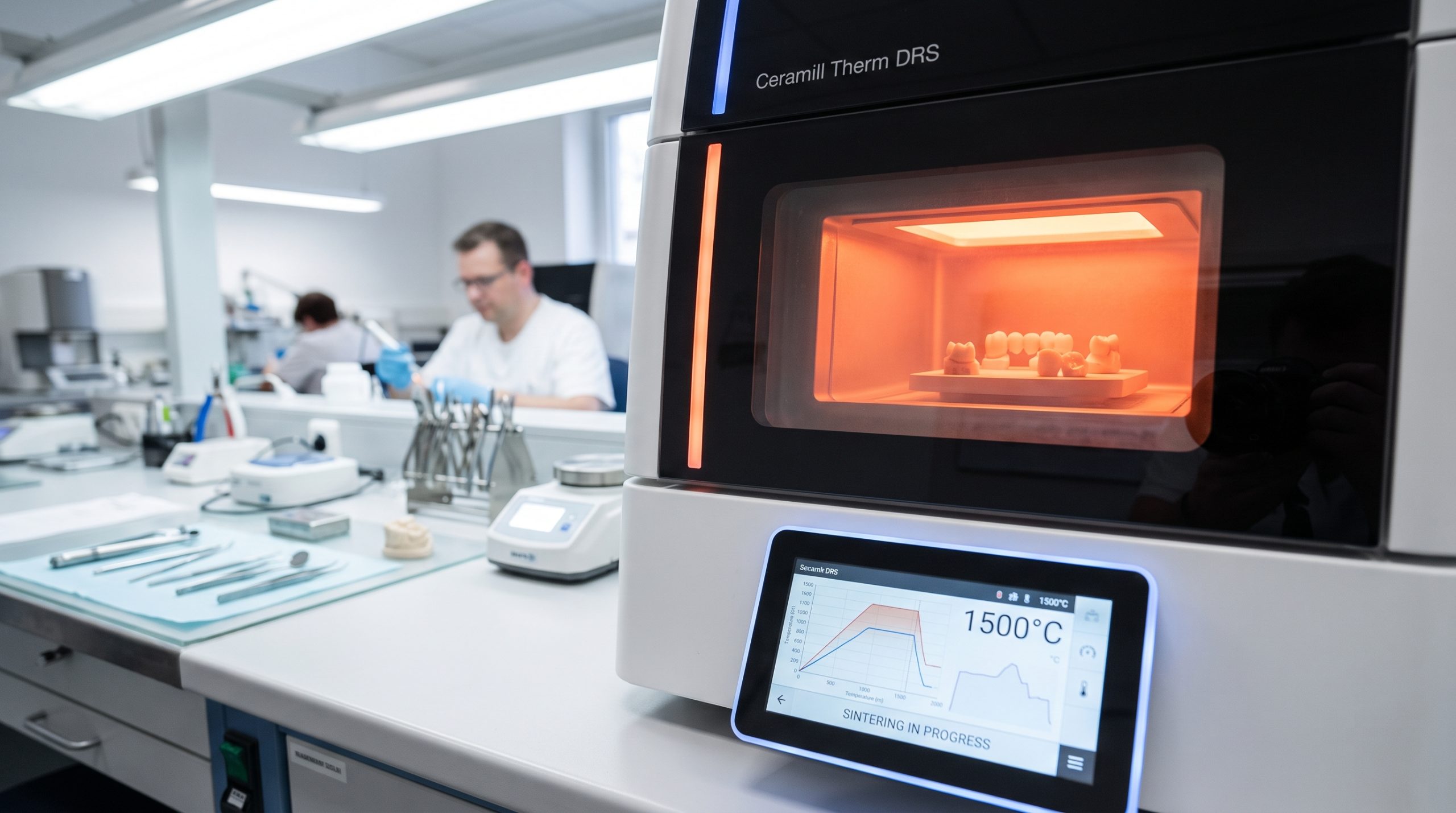
Key FAQs regarding 3Y zirconia center around optimizing sintering parameters, selecting appropriate indications, and avoiding fractures under high occlusal loads. When your lab processes 3Y Zirconia restorations, you will frequently encounter questions regarding temperature limits, wet vs. dry milling, and patient selection. Resolving these common concerns immediately is essential to maintaining high laboratory standards and minimizing remakes. This practical guidance helps you navigate everyday clinical and technical challenges with complete confidence.
By addressing these questions directly, you protect your digital production lines from simple processing errors. Our technical experts have collected the most frequent questions from lab managers around the globe to provide clear, actionable solutions. These answers reflect real-world lab experience and proven material science. Let’s address these essential questions to optimize your dental CAD/CAM workflows.
How can you optimize sintering cycles?
As you program your laboratory’s sintering furnaces, you must follow strict temperature guidelines to achieve optimal material properties. Why does this matter? Sintering at the wrong temperature will severely compromise both the strength and translucency of the final restoration.
To optimize your cycles, you must:
- Target a peak sintering temperature between 1,450°C and 1,530°C.
- Avoid rapid cooling curves that introduce destructive thermal stresses.
- Clean your sintering chamber regularly to prevent color contamination.
You will enjoy highly consistent shades and predictable strength when you stick to these verified temperature curves. By avoiding rushed cycles, you ensure that the crystal phases stabilize correctly. This scientific control is what guarantees long-term clinical durability for your patients. It is a simple but vital step for every modern digital workflow.
Can you mill this material wet?
You can technically mill these ceramic blanks on wet-milling machines, but dry-milling remains the industry-preferred method. But that is only the beginning… If you choose to wet-mill pre-sintered blocks, you must implement a strict drying cycle before sintering.
Wet-milling risks include:
- Internal steam pressure building up inside the block during rapid heating.
- Microscopic cracks forming as water trapped in the porous material boils.
- Slight shade distortions due to chemical interactions with milling coolants.
Key Takeaway: You will avoid major clinical and processing failures by following the manufacturer’s exact sintering profiles and ensuring all wet-milled restorations are thoroughly dried before firing.
Implementing these standard quality controls guarantees that your finished restorations always meet the highest standards of safety and performance.
Why choose ZrBrontec for your 3Y Zirconia?
You should choose ZrBrontec for your 3Y zirconia because our advanced, ultra-pure powder formulations ensure unparalleled batch consistency and predictable CAD/CAM shrinkage. When you source high-quality 3Y zirconia from our state-of-the-art factories, you are investing in reliable restorations that protect your business reputation. We manufacture premium blanks that mill smoothly, sinter predictably, and blend beautifully with natural dentition. This high standard of quality control ensures that your laboratory can operate with maximum efficiency and minimum waste.
Partnering with a dedicated manufacturer gives you access to direct technical support and optimized sintering configurations. We understand the daily pressures facing modern dental labs and CAD/CAM centers, and we design our products to solve your biggest production challenges. Let’s explore how our advanced dental ceramics can help you grow your business and satisfy your clinical clients. Our materials are trusted by leading laboratories worldwide.
What makes our raw materials superior?
As you evaluate different suppliers, you will find that our raw powders offer exceptional purity and grain-size consistency. Why does this matter? High-purity powders are crucial for preventing structural defects and achieving predictable shrinkage.
Our manufacturing advantages include:
- Advanced cold isostatic pressing (CIP) that ensures uniform density throughout the disc.
- Strict quality testing of every batch to guarantee consistent flexural strength.
- Highly stable shrinkage factors that make CAD/CAM software nesting completely predictable.
You will experience significantly less margin chipping during milling and a far better fit on the master model. By choosing our premium blanks, you reduce the time your technicians spend on manual adjustments and hand-finishing. This chemical and physical consistency translates directly into higher lab profits and happier clients. It is the ultimate foundation for your digital production line.
How can we help you scale your lab?
You can rapidly scale up your daily production by partnering with us for your CAD/CAM material needs. But that is only the beginning… We offer comprehensive technical guidance, custom sintering schedules, and fast global shipping directly from our factories.
Our partner benefits include:
- Direct factory pricing that improves your lab’s operating margins.
- Dedicated B2B technical support to help you optimize your CAD/CAM settings.
- A complete product portfolio covering high-strength, universal, and high-translucency grades.
Key Takeaway: You can dramatically lower your operational overhead and improve restoration consistency by sourcing your CAD/CAM blanks directly from a dedicated manufacturer like ZrBrontec.
| Production Challenge | Standard Milling Blanks | ZrBrontec Premium Blanks | Direct Lab Advantage |
|---|---|---|---|
| Shrinkage Consistency | Varies by batch (±1.5%) | Highly stable (±0.2%) | Perfect passive fit with zero software adjustments |
| Margin Stability | Prone to minor micro-chipping | High edge toughness | Ultra-clean margins that require no hand-finishing |
| Supply Reliability | Frequent backorders and delays | Direct factory supply lines | Uninterrupted production and faster delivery times |
Reviewing these unique manufacturing benefits demonstrates how our premium blanks can optimize your laboratory’s daily CAD/CAM performance.
Conclusion
Choosing the right zirconia grade is the single most important decision you make to guarantee the clinical durability and aesthetic success of your dental restorations. By mastering the physical differences between 3Y, 4Y, and 5Y formulations, your laboratory can eliminate premature crown fractures, avoid unappealing chalky margins, and maximize daily CAD/CAM productivity. Sourcing your materials directly from a trusted, quality-focused manufacturer ensures that your CAD/CAM nesting and sintering steps remain completely predictable and highly profitable.
If you are ready to eliminate remakes, streamline your material inventory, and deliver world-class restorations to your clients, contact us to explore our premium product line and request sample blanks. At ZrBrontec, we believe that world-class dental engineering starts with ultra-pure raw materials, and we are dedicated to helping dental laboratories around the globe achieve flawless fits and beautiful smiles, one disc at a time.
Technical and Clinical FAQ
Can I use 5Y zirconia for a multi-unit posterior bridge?
Absolutely not, as doing so introduces an extremely high risk of catastrophic restoration fracture under heavy chewing loads. Highly translucent 5Y zirconia lacks the tetragonal crystal phase and transformation toughening required to withstand high masticatory forces, meaning you should restrict its use strictly to single anterior crowns or delicate cosmetic veneers.
What’s the best sintering temperature to ensure maximum material density?
The optimal range is between 1,450°C and 1,530°C to lock in the desired physical and aesthetic properties. Firing your crowns below this temperature prevents the material from reaching full density, while over-firing triggers rapid grain growth that compromises both the flexural strength and light transmission of the restoration.
How do I know if my CAD/CAM margins are stable enough during milling?
You will observe sharp, uniform edges on your pre-sintered restorations without any micro-chipping or powdery flaking. High-quality blanks processed with diamond-coated burs under correct feed rates will maintain excellent edge stability, whereas poor-density materials or worn tools will result in jagged, weak margins that compromise the final fit.
Can I dry-mill pre-sintered zirconia without a liquid coolant system?
Yes, dry milling is actually the preferred method for processing pre-sintered green-state zirconia. Dry milling avoids the absorption of moisture, which eliminates the need for a long drying cycle and prevents the formation of internal steam-induced micro-cracks during the subsequent sintering phase.
How do I know if a patient is a good candidate for high-strength 3Y restorations?
Any patient presenting with severe bruxism or requiring a long-span posterior bridge is an ideal candidate for this ultra-tough grade. The exceptional flexural strength of over 1,200 MPa and high fracture toughness of 3Y formulations are mandatory for surviving intense occlusal forces and providing long-term clinical success.